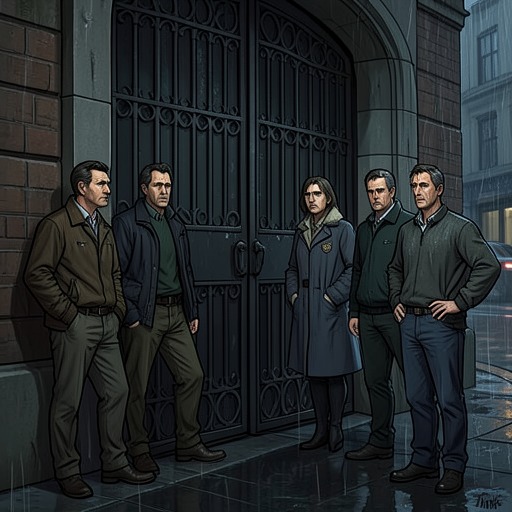
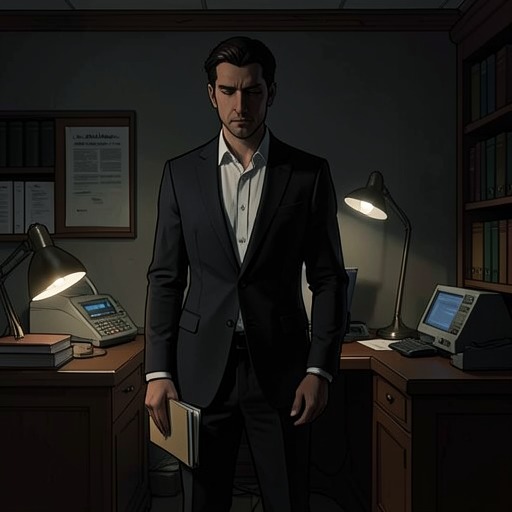
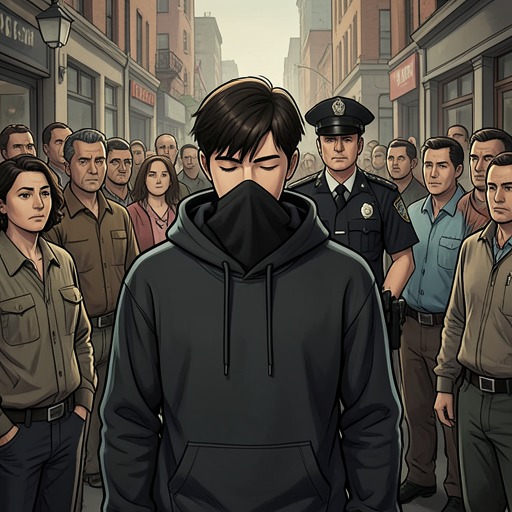
Event 1
Murder of Ben Rifkin
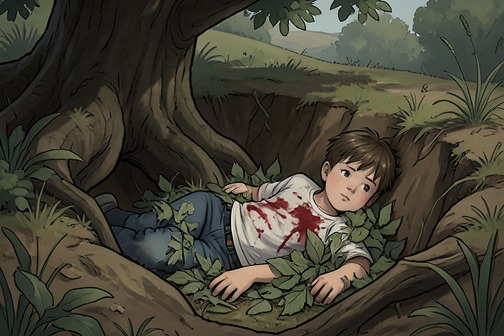
The murder of [Benjamin Rifkin](entity:character-recall-character-benjamin-rifkin-32488ffedd3e) is the central crime around which the novel’s investigation and trial revolve, but its decisive significance lies in the gap between a sharply documented death and an unresolved explanation. Benjamin, a fourteen-year-old [McCormick School](entity:location-recall-location-mccormick-school-dd4f0c514ec5) student, was found in [Cold Spring Park](entity:location-recall-location-cold-spring-park-c214120d077b) on [April 12, 2007](entity:time-recall-time-april-12-2007-db09c2cef9f7). The prosecution later identified his classmate [Jacob Barber](entity:character-recall-character-jacob-barber-72f25e661d23) as the killer, yet the case’s disputed evidence, uncertain motive, and eventual outcome leave the murder’s truth entangled with the limits of investigation and judgment.
## Discovery and Setting
Benjamin’s body was discovered along a smaller trail in Cold Spring Park, a sixty-five-acre stretch of pine woods bordering the school grounds. The park’s intersecting paths served as a route to McCormick School, which made the location familiar to students and joggers, including [Andrew Barber](entity:character-recall-character-andrew-barber-8b47cdbff3c8), who ran there most mornings. At 9:07 a.m., Paula Giannetto stopped her jogging watch to investigate what she thought might be an injured or unwell boy. Her first impression was wrong: she turned him over, saw that he had been killed, and fled to raise the alarm. The discovery occurred less than an hour after Benjamin had left home for the short walk to school.
The circumstances made an ordinary morning route seem suddenly unsafe. The initial searches of the park and neighborhood produced no witnesses, and the lack of news encouraged parents to fear that an unknown predator was at large. A police cruiser remained in the parking lot to reassure park users, while the trails themselves were largely abandoned. The contrast between a well-used public landscape and the apparent isolation of the crime became part of the case’s early uncertainty: the setting was close to school and home, yet no clear account of what had happened there emerged.
## What the Physical Evidence Established
The autopsy and scene investigation established that Benjamin had been stabbed three times in the chest. One wound was fatal on its own. The weapon was not recovered, and the wounds’ pattern and the condition of Benjamin’s clothing provided investigators with clues about the kind of knife used, but not a confirmed weapon or a complete reconstruction of the attack. The estimated size of the attacker was also uncertain because the body had been found on sloping ground.
A single fingerprint, preserved in Benjamin’s blood on a plastic tag inside his unzipped sweatshirt, became the most striking physical clue. It did not belong to Benjamin or Giannetto. The print would later be associated with Jacob, bringing the investigation to the student who became the accused. Yet the existence of a compelling clue did not answer every question: the murder weapon remained missing, and the physical evidence alone did not explain why Benjamin had been killed.
The location of the body also proved important to how the scene was understood. Giannetto first saw him lying facedown on an embankment, but the photographs Andrew later examined showed the body after it had been turned over. The distinction matters because the image that enters the case file is not an untouched view of the original scene. The account of the crime is assembled through discovery, handling, testimony, and later interpretation rather than preserved as a single, self-explanatory picture.
## The Prosecution’s Account and Its Unanswered Motive
At trial, [Neal Logiudice](entity:character-recall-character-neal-logiudice-18b620d30e1e) framed the murder as a deliberate act by Jacob. In his opening statement, he emphasized that Benjamin had been killed on a spring morning near the school and home he had left only minutes earlier. He presented the three wounds as evidence of choice and control, and argued that Jacob knew Benjamin would be in the woods because the boys had walked to school through the park for years.
But the prosecution’s explanation of motive shifted between competing possibilities. Logiudice speculated that Benjamin might have insulted, threatened, or bullied Jacob, while also suggesting that Jacob had planned the killing in advance. Andrew recognized the strain between an account of a sudden loss of temper and one of weeks of deliberation: the prosecution appeared to invoke both, without resolving why Jacob would have acted. The uncertain motive was not a minor gap in the narrative; it exposed the difference between presenting a plausible theory and demonstrating what actually happened.
The trial repeatedly returned to Benjamin’s death through testimony and exhibits. Giannetto described approaching the body alone after listening to music on her iPod, and the prosecution drew out the details of her discovery. A separate witness recalled hearing a child’s voice say, “Stop, you’re hurting me.” That brief testimony offered another fragment, but did not supply a complete account of the encounter or identify who spoke. The case therefore accumulated discrete recollections and records without converting them into an uncontested narrative.
## The Story, the Case, and the Limits of Proof
The investigation also acquired a disturbing textual clue when Andrew received an email linking him to a newly created [Facebook](entity:organization-recall-organization-facebook-72fee13d0373) group called “Friends of [Ben Rifkin](entity:character-recall-character-ben-rifkin-ee0ef547649e).” Later, [Derek Yoo](entity:character-recall-character-derek-yoo-64a9030f135a) testified that Jacob’s story described the knife, the chest wounds, and a character whose name, “Brent Mallis,” pointed unmistakably to Benjamin for those who knew him. The story’s resemblance to the killing deepened suspicion around Jacob, but it remained a piece of evidence to be interpreted, not a direct account that resolved the murder on its own.
That distinction between event and record structures the murder’s place in the novel. The grand jury proceeding, trial exhibits, witness testimony, online material, and Andrew’s retrospective narration each present a different form of access to the crime. The grand jury is described as a process in which the prosecutor largely controls what jurors hear, while the later trial places selected details before a courtroom and a watching public. Neither setting removes the uncertainty that surrounds stale or incomplete evidence. The records make the murder legible enough to prosecute, but their arrangement also shows how a case can acquire persuasive form without yielding certainty.
The murder remains the fixed fact behind these competing accounts: Benjamin is dead, and the circumstances of his death demand explanation. What remains contested is whether the evidence identifies Jacob as the killer and whether the theories offered for the crime can withstand scrutiny. By separating the certainty of the death from the uncertainty of responsibility and motive, the novel makes the murder not only a crime to be investigated but a test of what legal procedure, testimony, and family conviction can establish.
Event 2
Discovery of Ben Rifkin's body
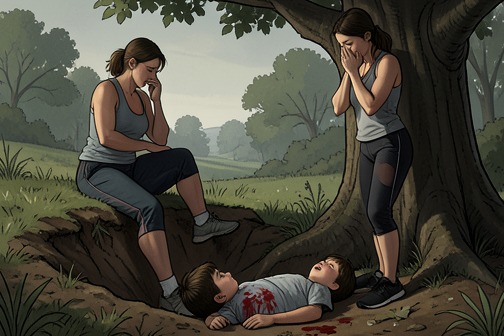
The discovery of [Ben Rifkin](entity:character-recall-character-ben-rifkin-ee0ef547649e)’s body in [Cold Spring Park](entity:location-recall-location-cold-spring-park-c214120d077b) on [April 12, 2007](entity:time-recall-time-april-12-2007-db09c2cef9f7), is the moment the case begins to take shape: an eighth grader who had left home for school was found dead less than an hour later, and the park’s familiar paths became the setting for a murder investigation. Paula Giannetto, out jogging, came upon the body and alerted the authorities.
## Place and Circumstances
Cold Spring Park covered sixty-five acres of pine woods adjoining the school grounds. Jogging paths crossed and branched through the woods before joining a trail that circled the park. [Andrew Barber](entity:character-recall-character-andrew-barber-8b47cdbff3c8) knew the trails from his own morning runs. On April 12, 2007, Ben’s body lay in a small gully off one of the lesser paths, near the foot of a tree. The wooded setting was close to school, but the branching trails made the spot secluded.
Giannetto encountered Ben at 9:07 a.m., the time recorded when she stopped her jogging watch. He had left home for the short walk to school less than an hour earlier. At first, she did not recognize that he was dead and rolled him over, hoping he had fainted or was sick. She then saw the blood on his shirt, backed away, and ran. Her attempt to help therefore became the circumstance that revealed the killing.
## The Body and the Initial Evidence
The murder-scene photographs later shown to Andrew presented Ben lying face up, but that was not how Giannetto first found him. He had been face down, with his head downhill and his feet above it; after she rolled him over, he remained in the position depicted in the photographs. The medical examiner would explain that the slope could account for the unusual flush of his face, caused by blood draining toward his head. The distinction between the body as first found and as later photographed mattered to the reconstruction of the scene.
Ben had been stabbed three times in the chest. One wound was fatal on its own. The wounds and damage to his shirt indicated a jagged-edged weapon, which had not been recovered. There were no defensive wounds. Investigators also noted a single clear fingerprint in Ben’s blood on a plastic tag inside his unzipped sweatshirt, a location consistent with someone having seized the garment. The print matched neither Ben nor Giannetto, giving investigators a specific clue while leaving the person responsible unidentified.
## The Investigation Begins
The discovery set off an immediate chain of official calls. Andrew, then First Assistant at the [District Attorney’s Office](entity:organization-recall-organization-district-attorne-62fb646c424c), recalled first hearing from [CPAC](entity:organization-recall-organization-cpac-1234cc8f768e), the state police unit, followed quickly by calls from the [Newton](entity:location-recall-location-f7ba52918bf2) police and the duty district attorney. He could not be certain of their exact order, but explained that he was notified of every murder in the county as standard procedure. The call reached him around nine that morning, immediately after the body was discovered.
The discovery thus establishes both the case’s physical starting point and the first investigative uncertainties: a precise time and location, a witness whose actions altered the body’s position, a weapon still missing, and a fingerprint whose source was not yet known. The ordinary setting of a morning jog and a familiar park trail gives way to evidence that demands reconstruction, while the initial facts leave the identity of the killer unresolved.
Event 3
Reopening of McCormick School after Ben Rifkin's murder
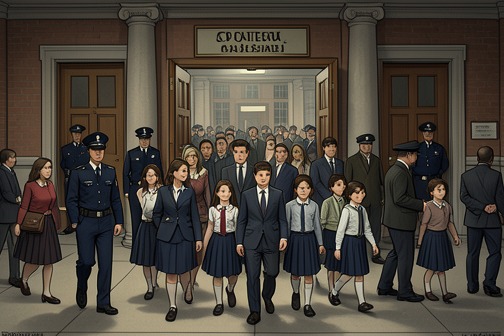
The reopening of [McCormick School](entity:location-recall-location-mccormick-school-dd4f0c514ec5) five days after [Ben Rifkin](entity:character-recall-character-ben-rifkin-ee0ef547649e)’s murder is presented not as a return to normal, but as an uneasy performance of normality under public scrutiny. [Andrew Barber](entity:character-recall-character-andrew-barber-8b47cdbff3c8) accompanies Jacob to school amid heightened security, while the family’s tension, the students’ online conversations, and increasingly sensational news coverage reveal how the murder has altered ordinary life.
## Anxious return to school
That morning, Andrew, [Laurie](entity:character-recall-character-laurie-6a86783f9333), and Jacob follow their usual routine—showers, coffee and bagels, and a glance at email, sports scores, and the news—but move through it tensely. They are all up by six-thirty and still dawdle until they are running late. Laurie’s unease is particularly visible: although she has lived alongside Andrew’s work as a prosecutor, the violence has entered her own life, and she struggles to maintain her composure. The reopening, only five days after the murder, has rattled all three.
The school entrance is crowded with parents escorting children, family vehicles, and nearby news vans. Police sawhorses block both ends of the circular driveway; officers guard the entrance and wait in a cruiser. Andrew parks the family minivan almost a block away, and he and Jacob sit watching the scene before Jacob murmurs his reaction. The familiar school has become a place approached through barriers, cameras, and adult vigilance.
## Security as public reassurance
Inside the foyer, the security station combines hand inspections of coats and backpacks with metal-detecting wands used by four [Newton](entity:location-recall-location-f7ba52918bf2) police officers. Andrew considers the searches disproportionate: the murder victim’s body was not found on school grounds, and, in his view, there is no reason to think the killer would bring a weapon into the school. He understands the measures chiefly as a display for anxious parents, a visible attempt to make the return feel controlled.
A dispute over a student’s sweatshirt exposes the improvised character of that control. An officer deems its lettering forbidden under the school’s hastily devised rules, while the student argues that it is a clothing brand and refuses to surrender an expensive garment. Andrew approaches as the disagreement reaches an impasse. The episode gives the security procedure a small but telling consequence: fear has brought an institutional show of protection, yet applying it also creates new conflicts at the school door.
## The school and the online audience
The reopening exists alongside an expanding online conversation about the murder. Students post casually about the case and the park, while Andrew reads their messages with an eye to preserving them through a subpoena to [Facebook](entity:organization-recall-organization-facebook-72fee13d0373). The apparent intimacy of students’ online exchanges does not make them private from adults or from the legal process. The school’s return to routine is therefore accompanied by a second kind of scrutiny, less visible than the police presence but consequential to the investigation.
Jacob’s public image also spreads beyond the school. A supportive website and Facebook group collect messages affirming his innocence, while negative posts are filtered out. His name trends on Twitter, and strangers send him texts: many are hostile, though some are admiring or flirtatious. Jacob says the messages are about two to one negative, considers the attention sufficient, and does not want to change his number. Laurie advises him to stay off social media until the case is over; he says he only reads and does not post. The support and hostility coexist, turning the charged school reopening into part of a much wider public judgment of a teenager whose case is still unfolding.
## From school gates to courtroom headlines
The coverage accompanying the reopening soon becomes explicit in its judgment. [After](entity:expression-recall-expression-after-f466acd0fe53) Jacob is charged, a Globe front-page headline identifies him as the district attorney’s teenage son charged in the Newton killing. The Herald’s cover labels him a monster and pairs his photograph with a claim that he has been unmasked in a knife murder; its teaser also invokes Andrew’s removal from the case and alleged cover-up. The family’s earlier concern about appearances now meets a media narrative that presents accusation as revelation.
The publicity continues at the courthouse. A Fox 25 news van films the family as they leave home, and reporters and cameras gather at the courthouse entrance. Andrew is relieved that Jacob can walk in from the street rather than arrive through the prisoners’ exit: remaining out on bail preserves some freedom and dignity while the case proceeds. The school reopening thus marks an early point in a widening sequence, from guarded school gates to a public trial of Jacob’s character in headlines and online forums. Its central contrast is between the ordinary routines the family tries to resume and the security measures and public narratives that make those routines impossible to recover unchanged.
Event 4
McCormick student interviews
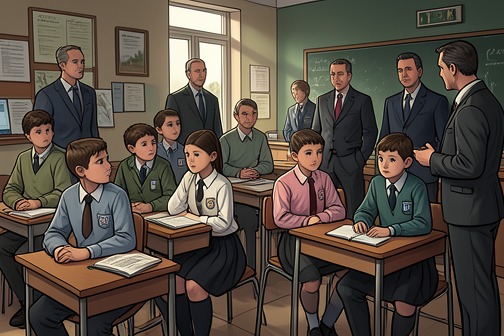
The [McCormick student interviews](entity:event-recall-event-mccormick-student-inter-abcfe80fe5f4) begin as an attempt to find witnesses after [Ben Rifkin](entity:character-recall-character-ben-rifkin-ee0ef547649e)’s murder and become an unsettling indication that students may know more than they are willing to say. Conducted by [Andrew Barber](entity:character-recall-character-andrew-barber-8b47cdbff3c8), [Paul Duffy](entity:character-recall-character-paul-duffy-dea30aca2158), and other investigators under rules negotiated with the school, the interviews move the case from a search for individual clues toward the possibility of a wider silence among Ben’s classmates.
## Setting and Conditions
The interviews start after school, following a day of class meetings and grief counseling. Plainclothes [CPAC](entity:organization-recall-organization-cpac-1234cc8f768e) detectives have gone from classroom to classroom asking students to share tips, anonymously if they prefer; the children’s dull response gives little immediate promise of cooperation. The investigators’ access is limited by the school’s insistence on safeguards. Students outside Ben’s homeroom are off limits unless there is a specific reason to think they may know something, and a student may have a parent or lawyer present and may end an interview at any time.
The restrictions follow direct intervention by the school board and the mayor, who press [Lynn Canavan](entity:character-recall-character-lynn-canavan-b05bc0579d0c) to slow the investigation. The school principal initially refuses to let the investigators interview any student they choose. Andrew recognizes that the investigators would have acted differently had the crime occurred in an urban setting, but in this suburban community they negotiate rather than simply enter. Although he regards many of the eventual conditions as rights the children already possess, he sees the negotiations as costing valuable time. The rules protect the students while also making the interviews a contested public matter.
## Interviews and the Emerging Pattern
At two o’clock, Andrew and Paul take over the principal’s office to interview their highest-priority witnesses: Ben’s close friends, students known to walk through [Cold Spring Park](entity:location-recall-location-cold-spring-park-c214120d077b), and students who have specifically asked to speak with investigators. Two dozen interviews are scheduled for the pair, while other CPAC detectives conduct interviews in parallel. Andrew expects most conversations to be brief and unproductive; the investigators are, in his image, casting a broad net rather than following a settled lead.
[After](entity:expression-recall-expression-after-f466acd0fe53) only three or four interviews, that expectation gives way to suspicion. At first, Andrew and Paul interpret the students’ shrugs, evasions, wandering eyes, and casual verbal habits as ordinary adolescent resistance to adults. Their experience as fathers makes that explanation seem plausible. But the answers go beyond claims of ignorance: some students deny knowing Ben at all, while others claim that nobody spoke to him or knew who had harmed him. Andrew and Paul already know that Ben had friends, so the denials appear not merely incomplete but false. For Andrew, the friends’ sudden disavowal of Ben reads as a betrayal.
The students’ varying attempts to appear truthful sharpen rather than resolve the investigators’ concern. Some overplay signs they associate with honesty, becoming unusually direct and self-assured when making implausible denials; others seem uncomfortable even as they lie. Andrew notes that these behaviors do not establish what any particular student knows. Their significance lies in the accumulating pattern: the interviews are not producing ordinary gaps in memory or knowledge but accounts that seem shaped to conceal association with the victim.
## From Canvassing to Suspected Silence
As the interviews continue, Andrew and Paul exchange suspicious glances and slow the process to challenge the clearest falsehoods. Paul jokes that the students are observing a code of silence, but neither investigator says aloud what he is beginning to suspect. The mood changes from routine witness-gathering to the sense that the investigation has opened onto a new possibility.
Until then, they had considered and discounted the possibility that another student was involved. They had seen no evidence pointing to a student suspect, no obvious outcast, no trail of careless schoolboy evidence, and no clear motive in the form of revenge, outlaw fantasies, or a classroom feud. The interviews unsettle that assessment. They do not identify a culprit or explain why the students are evasive; they do establish, for Andrew and Paul, that the children may collectively know something they are withholding. The turn matters precisely because suspicion arrives without a corresponding answer.
## The Question Behind the Investigation
The interviews belong to a larger struggle over what the investigation can establish and what the death means to those left behind. [Dan Rifkin](entity:character-recall-character-dan-rifkin-fccce31db74f) asks Andrew why the person who killed Ben did it, insisting that he has questions beyond evidence and court procedure. He then asks what distinguishes parents who manage to survive the loss of a child and what happens to those who never recover. Andrew’s response is to recommend family and community support, a victim advocate, and a survivors’ group; he stresses that grief cannot be borne alone.
Dan’s questions give the interviews a human context without supplying an explanation for the students’ behavior. The case is at once a procedural inquiry into who knew what and a bereaved father’s attempt to find meaning and a way to endure. When Dan later appears near the park during the search, Andrew remembers him as a small, solitary figure crossing the open playing fields with his head bowed and his hands in his coat pockets. That image underscores how little the investigative process can do for the personal question Dan cannot set aside.
## Narrative Significance
The interviews also expose how easily a community’s ordinary routines can become a barrier to knowledge. The students are not presented as a single, proven conspiratorial group; the evidence shows a repeated pattern of denial that causes Andrew and Paul to revise their earlier judgment. The distinction is important: the interviews produce suspicion, not a definitive account of who is responsible or what the students know.
The episode’s force comes from that gap between what the investigators expected and what they encounter. A school canvass designed to gather small, individual observations instead reveals the possibility of collective silence. In the wider narrative, that reversal anticipates the difficulty of separating evidence from assumption: the investigators must take the denials seriously enough to question their initial theory, while the interviews themselves leave the central questions unresolved.
Event 5
Facebook accusation against Jacob Barber
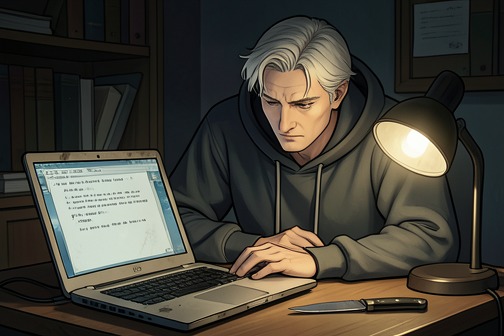
[Derek Yoo’s Facebook accusation against Jacob](entity:action-recall-action-facebook-bf51f17ffd69) Barber is a pivotal discovery in [Andrew Barber](entity:character-recall-character-andrew-barber-8b47cdbff3c8)’s investigation: Derek publicly claims that Jacob has a knife and that he has seen it, and Andrew subsequently finds a folding knife hidden in Jacob’s bedroom. The post converts an online dispute into a concrete lead, while exposing how little Andrew knows about his son’s life beyond the family’s sight.
## The post and its setting
The accusation appears in a conversation on Jacob’s [Facebook](entity:organization-recall-organization-facebook-72fee13d0373) page in the immediate aftermath of [Ben Rifkin](entity:character-recall-character-ben-rifkin-ee0ef547649e)’s murder. Andrew reaches the page after following a link sent to his email, which takes him to a newly created Facebook group called “ Friends of Ben Rifkin .” He then turns to Jacob’s own page, where a separate discussion is still active. The scene’s documentary texture matters: the reader encounters the accusation as a dated post within a stream of other users’ messages, not as a later summary of what someone supposedly said.
Derek’s message is dated April 15, 2007, at 2:25 p.m. It states, “Jake, everyone knows you did it. You have a knife. I’ve seen it.” The accusation combines a claim about Jacob’s guilt with a specific assertion about his possession of a knife. Andrew fixates on the final claim; as he reads, the words hold his attention until, in his account, their letters seem to break down into pixels.
## A friendship becomes a source of evidence
The force of the post comes partly from who wrote it. Derek was Jacob’s good friend, had been to the Barber home many times, and had known Jacob since kindergarten. Andrew’s shock is therefore not simply a reaction to an accusation from a stranger. The message comes from someone familiar with the family and with Jacob over many years, making its claim about the knife difficult to dismiss as idle rumor.
The exchange also places that claim amid the unsettled talk surrounding the murder. Other messages on Jacob’s page include challenges to rumors and warnings that careless statements could get people hurt. Derek’s post stands out from that general atmosphere because it is specific: he says not only that Jacob has a knife, but that he has seen it. The post cannot, by itself, establish what happened to Ben. Its immediate importance is that it gives Andrew a reason to look for the object Derek describes.
## Andrew’s search
The next morning, Andrew arranges to leave [Laurie](entity:character-recall-character-laurie-6a86783f9333) and Jacob before him, telling them that he has a meeting at the [Newton](entity:location-recall-location-f7ba52918bf2) police station and does not want to drive back and forth to [Cambridge](entity:location-recall-location-07e46a478d5d). Once they are gone, he goes to Jacob’s room and searches it. The change from reading to action is swift: a public online message becomes the prompt for a private search by Jacob’s father.
Andrew finds the knife in the top drawer of Jacob’s bureau, loosely concealed inside an old white T-shirt. He unfolds the shirt and discovers a folding knife with a black, rubberized handle. Open, it is about ten inches long; its blade is curved and serrated, with a pointed end. Andrew’s attention to its particular form follows his discovery of it, but the event’s decisive fact is its location: Jacob has kept a knife in his room, just as Derek’s post had claimed.
## Consequence and narrative significance
The accusation changes the meaning of Andrew’s earlier trust in Jacob. Reading the messages, Andrew recognizes that parents cannot witness every part of a child’s life, online or otherwise, and concludes that the protection Jacob needed had not been provided. That realization gives the discovery a consequence beyond the knife itself: Andrew must confront a gap between the son he believed he knew and the life suggested by the message and the hidden object.
The sequence does not make Derek’s post a complete explanation of the murder. Instead, it shows how a fragment of social-media conversation can redirect an investigation and reshape a parent’s understanding, while leaving the larger question of guilt unresolved. The post is both an accusation and a lead; the knife corroborates its concrete claim about possession, not the claim that Jacob killed Ben. By presenting the message within a digitally preserved conversation and then following Andrew into Jacob’s room, the narrative links public talk, parental suspicion, and physical evidence without treating them as interchangeable forms of proof.
Event 6
Andrew Barber's discovery and disposal of Jacob's knife
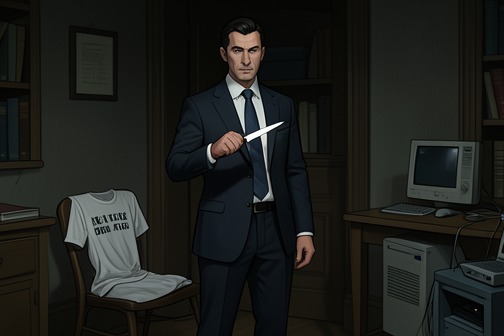
[Andrew Barber](entity:character-recall-character-andrew-barber-8b47cdbff3c8)’s discovery and disposal of [Jacob Barber](entity:character-recall-character-jacob-barber-72f25e661d23)’s knife is a turning point in the investigation and in Andrew’s role as both father and former prosecutor. He finds the folding knife hidden in Jacob’s room, then removes it from the house and ultimately discards it instead of preserving it for forensic examination. Andrew describes the decision as an effort to protect Jacob from a misleading accusation, but his later grand-jury testimony exposes the cost of acting on conviction rather than evidence: he never tested the knife, and says he did not need a test because he already knew it was the wrong one.
## Discovery in Jacob’s Room
The discovery follows a message that has left Andrew staring at the screen, unable to move. The next morning, after [Laurie](entity:character-recall-character-laurie-6a86783f9333) and Jacob have left, he tells them he has a meeting at the [Newton](entity:location-recall-location-f7ba52918bf2) police station and searches Jacob’s room. In the top drawer of the bureau, inside an old white T-shirt, he finds a folding knife with a black rubberized handle. The concealment is casual rather than elaborate: the knife is simply wrapped and tucked away.
Andrew unfolds it and studies an object that resists being treated as an ordinary tool. It is about ten inches long when open, with a four-finger grip, a hooked blade, a serrated ripping edge, and a pointed tip; holes drilled through the blade appear designed to reduce its weight. He sees it as sinister and beautiful, a lethal thing whose shape makes it difficult to dismiss. The description gives the knife a physical presence before its evidentiary meaning is settled: it is not yet proof of anything, but it has become impossible for Andrew to ignore.
## Confronting Jacob and Removing the Knife
Andrew brings the knife into a conversation with Jacob, setting it on the table between them. With the blade folded into its handle, its menace has receded; it looks like a tool. Andrew asks Jacob what it is, and Jacob answers that it is a knife. The exchange puts the object in the open between father and son, but it does not resolve what it means or why it was hidden.
Later, Andrew is asked what he did with it. He says he got rid of it, then specifies that he threw it away in a dumpster somewhere, not at home. His stated reasoning is twofold: he wanted the knife out of his house, and he did not want anyone using it to make Jacob look guilty when, as Andrew believed, he was innocent. The disposal is therefore not a neutral act of tidying or safekeeping. It removes a potentially testable object from the chain of evidence at precisely the moment when Andrew’s certainty about Jacob is shaping what he considers necessary.
## Grand-Jury Testimony and the Untested Claim
The episode is framed by Andrew’s testimony before the grand jury, where [Neal Logiudice](entity:character-recall-character-neal-logiudice-18b620d30e1e) presses him on the choice. Andrew says he wanted the search for the real murder weapon to succeed because finding it would have helped prove his son innocent. Logiudice turns that explanation back on him: Andrew disposed of Jacob’s knife without submitting it for tests of fingerprints, blood, or fiber traces, even though he had threatened Jacob that such testing might occur.
Andrew’s answer is not that testing was impossible, or that the knife had already been examined. He maintains that it was the wrong knife and that he did not need a test to confirm that. Under questioning, he repeats that he already knew. The repetition gives his testimony its central tension: Andrew frames disposal as protection grounded in certainty, while the missing forensic examination means that certainty cannot be checked against the evidence he discarded.
## Consequences and Narrative Significance
The knife’s route—from the bureau drawer to the table, then out of the house and into an unspecified dumpster—marks a shift in Andrew’s relationship to evidence. As a former prosecutor, he understands the value of testing; as Jacob’s father, he acts on his belief that the knife could be used against his son. The two roles do not simply coexist. In this episode, loyalty determines which questions Andrew refuses to ask of the object.
The later grand-jury account turns a private decision into public scrutiny. The examination makes Andrew explain not only what he did, but what he chose not to learn. His claim that the knife was the wrong one remains an assertion, not a forensic finding, because he disposed of it without testing. The scene thus complicates the distinction between evidence and interpretation: the knife may have appeared incriminating, Andrew may have believed it irrelevant, but his intervention ensures that the object cannot settle the question. Its decisive consequence is not proof of guilt or innocence; it is the loss of a chance to test Andrew’s conviction against material evidence.
Event 7
Interrogation of Leonard Patz
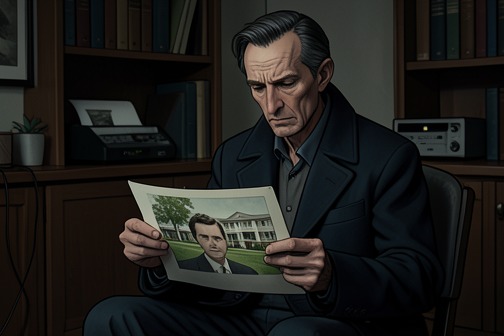
The [Interrogation of Leonard Patz](entity:event-recall-event-interrogation-of-leonar-3960591af8cb) is a brief but consequential episode in which [Andrew Barber](entity:character-recall-character-andrew-barber-8b47cdbff3c8)’s search for a suspect narrows onto a man whose record and admission of being in [Cold Spring Park](entity:location-recall-location-cold-spring-park-c214120d077b) make him seem plausible, but do not establish that he killed [Ben Rifkin](entity:character-recall-character-ben-rifkin-ee0ef547649e). Andrew presses the detectives to keep questioning Patz until his lawyer intervenes. The interview shows how urgency and professional instinct can turn circumstantial details into a prosecutorial story—and how the need for a story can outrun what the evidence actually proves.
## Background and suspicion
Andrew’s attention is drawn to Patz when [Paul Duffy](entity:character-recall-character-paul-duffy-dea30aca2158) brings him a Board of Probation record. It lists several allegations and charges involving indecent conduct, including an accusation concerning a minor that remains pending. The record makes Patz an alarming figure in the neighborhood, but the details do not connect him to Ben’s death. Duffy says Patz is twenty-six and lives near the park, in the Windsor condominium complex. A mug shot gives Andrew a face to consider alongside the record.
Andrew feels from this first encounter that Patz might be the person responsible. Yet the narration qualifies the intuition at once: Andrew is desperate for a suspect and knows that he wants to have this feeling because he needs to produce something. He distrusts his own suspicion without dismissing it. His account of expertise as an instinct formed through accumulated cases, mistakes, and technical knowledge explains why he is unwilling to ignore that gut feeling; it also reveals why the feeling is not self-validating. Duffy identifies a central weakness in the lead: Patz’s record contains no history of violence or weapons.
## The interview and its limits
By the afternoon, detectives have Patz in an interview room at the [Newton Police Station](entity:location-recall-location-newton-police-statio-1b5c64356c13). A camera, concealed in a schoolhouse clock, records him with his consent after detectives inform him that recording is required. His image appears on a small screen in the detective bureau, where [Newton](entity:location-recall-location-f7ba52918bf2) and [CPAC](entity:organization-recall-organization-cpac-1234cc8f768e) detectives watch from outside. The setup makes the questioning a performance observed by an audience, although the detectives initially see little to respond to.
Patz says that he walks in the park every morning, but insists that he was nowhere near the place where Ben was killed. He says he does not take that route, did not see or hear anything, and did not know Ben. As he speaks, he counts these denials on his fingers. Andrew’s reply is not that the denials have been disproved; instead, he treats Patz’s presence in the park as a reason to keep pressing him.
Andrew argues that Patz is their only real suspect: a child has been killed, Patz is attracted to boys, he knows the park, walks there routinely, and is physically capable of overpowering the victim. From these details Andrew constructs what he calls motive, means, and opportunity. His logic moves from a record about sexual offenses to a suspected motive, then from familiarity with the park to opportunity. The interview does not supply independent confirmation of that chain. Patz’s admission establishes that he was in the park, while his denials leave the crucial connection to Ben unresolved.
Andrew is especially impatient because Patz’s lawyer is about to end the questioning. He tells Duffy to go back in and obtain a confession that he could take to the grand jury that afternoon. The urgency makes the interview’s purpose plain: Andrew wants more than clarification; he wants an admission capable of carrying the case forward. But the pressure cannot itself fill the evidentiary gaps, and the scene records no confession.
## Counsel ends the questioning
[Jonathan Klein](entity:character-recall-character-jonathan-klein-24d9eee6e9d8) arrives in the detective bureau carrying a battered lawyer’s bag. He is described as slight and slightly stooped, with long white hair and a white goatee; his quiet greeting to Andrew is followed by a handshake marked by genuine warmth. Andrew respects Klein as intelligent, legally knowledgeable, and unusually honest. Their personal regard contrasts with the adversarial work underway: Klein is there to represent Patz, while Andrew wants the suspect to keep talking.
Andrew asks whether Klein will let his client continue. Klein declines, telling Andrew that he trusts him too much for that. The exchange draws the interrogation to a close: Patz’s questioning ends when counsel intervenes, not when the detectives resolve whether he was involved. The distinction matters. The episode gives the investigation a suspect and a set of suspicions, but not the confession Andrew sought or an established account of Patz’s role in the killing.
## From investigation to courtroom story
The trial later makes clear how sharply the case against [Jacob Barber](entity:character-recall-character-jacob-barber-72f25e661d23) depends on narrative construction. [Neal Logiudice](entity:character-recall-character-neal-logiudice-18b620d30e1e) describes Ben as a fourteen-year-old found dead in Cold Spring Park, then presents the killing as the culmination of a boy’s temper suddenly breaking. His argument turns bullying and Jacob’s alleged anger into a simple causal account, repeating the idea that the defendant “snapped.” The narrative makes the prosecution’s task legible to the jury, but the narrator characterizes Logiudice’s technique as stronger than the certainty of his explanation.
The opening statement also presents Ben as a regular teenager rather than a saint: someone who teased Jacob, but whose ordinary flaws cannot make him responsible for his own death. Logiudice contrasts Ben’s popularity and confidence with Jacob’s supposed loneliness and outsider status, then proposes that Jacob carried a knife and an idea into the park before some later provocation supplied the trigger. Yet the account of the trial emphasizes that Logiudice cannot establish what that trigger was. He offers possibilities, including insults or bullying, and concedes that the answer may never be known.
That courtroom uncertainty throws the Patz interrogation into relief. In both episodes, the search for a motive presses investigators and advocates to arrange fragments into a coherent story. Andrew’s suspicion rests on Patz’s record, his routine presence in the park, and his admission that he was there that morning; Logiudice’s theory of Jacob rests on a proposed temper, bullying, and a conjectured trigger. Neither the urgency of an investigation nor the persuasive force of a trial theme turns an inference into a demonstrated fact. The interrogation’s decisive outcome is therefore limited but revealing: the questioning stops, the lead remains unresolved, and the story of the crime continues to be contested.
Event 8
Cold Spring Park volunteer knife search
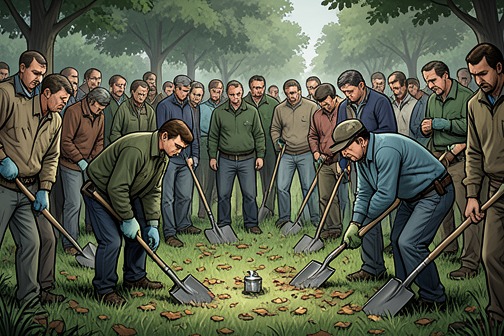
The [Cold Spring Park volunteer knife search](entity:event-recall-event-cold-spring-park-volunt-b1dc0d9a8716) was a town-wide effort on Sunday, [April 22, 2007](entity:time-recall-time-april-22-2007-1a385e1b92c3), ten days after [Ben Rifkin](entity:character-recall-character-ben-rifkin-ee0ef547649e)’s murder. Hundreds of residents combed the park for the missing knife, imagining that fingerprints, blood, or another trace might resolve the case. The search briefly offered a way to act amid uncertainty, but the kitchen knife eventually found in the park came with no obvious forensic answer and no confirmed connection to the murder.
## Background and Stakes
The search grew out of the investigation’s unresolved need to locate the weapon. For the town, the missing knife had become more than an object: its recovery seemed capable of bringing an end to the waiting and uncertainty that had worn people down. Volunteers expected that physical evidence might unlock the mystery and allow the community to exhale.
That expectation shaped the morning’s purpose. Assembling to search meant that residents could participate in the investigation rather than remain spectators to it. Yet the hope placed on the knife also exposed the limits of what a single discovery could promise: a recovered object might offer evidence, but only examination could establish what it showed.
## The Community Search
The volunteers gathered on a raw, drizzly morning at [Cold Spring Park](entity:location-recall-location-cold-spring-park-c214120d077b). They represented different parts of town: students from McCormick, including some who had been friends with Ben and others from different school groups; young parents; and community organizers. [Paul Duffy](entity:character-recall-character-paul-duffy-dea30aca2158) explained how the search would proceed, after which teams walked across the park and searched assigned sections of the woods.
The effort had a determined, almost relieving quality. People who had been living with uncertainty were finally given something practical to do, and many believed the search would soon settle the matter. [Andrew Barber](entity:character-recall-character-andrew-barber-8b47cdbff3c8) did not take part. His absence distinguishes him from the cross-section of residents who joined the organized effort; the account does not state why he stayed away.
## The Knife Is Found
During the search, Duffy came to the back deck of the Barber home and told Andrew that a knife had been found in the park, in mud beside a lake. Andrew responded that he had expected it to turn up and immediately asked whether it bore prints, blood, or anything else of evidentiary value. The report offered a concrete discovery, but not yet an answer.
Duffy said there was nothing obvious on the knife and that it had been sent to the laboratory. He described dried algae covering it like green powder, and identified it as an ordinary kitchen knife. When Andrew suggested that it belonged to [Leonard Patz](entity:character-recall-character-leonard-patz-efe0f3e856b7), Duffy did not confirm the identification, answering only that he did not know and that it was possible. The recovered object’s type and location thus became known, while its ownership and connection to the murder remained unresolved in this conversation.
## Narrative Significance
The search turns communal hope into a test of evidence. Hundreds of people invest a day’s effort in the belief that one object will end uncertainty; the discovery supplies an object, but its lack of obvious marks and uncertain identity prevent that simple resolution. The scene’s movement is from expectation toward qualified possibility, not from mystery to proof.
The episode also places the investigation’s public and private pressures side by side. The volunteers search assigned parts of Cold Spring Park under Duffy’s direction, while news of the find reaches Andrew at home and prompts him to interpret the knife through his suspicion of Patz. His immediate attribution is not a confirmed fact: Duffy remains cautious, and the laboratory examination is still pending. The search therefore advances the physical inquiry without yet establishing who used the knife or what it can prove.
Event 9
Fingerprint match implicating Jacob Barber
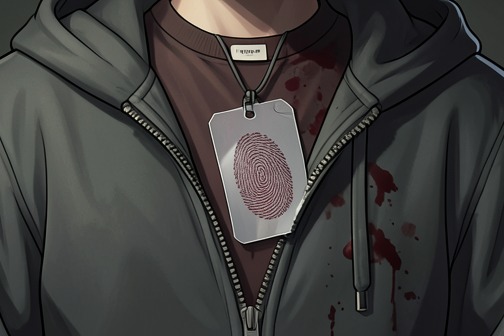
The fingerprint match implicating [Jacob Barber](entity:character-recall-character-jacob-barber-72f25e661d23) is the first specific forensic link between Jacob and the killing of [Ben Rifkin](entity:character-recall-character-ben-rifkin-ee0ef547649e). A print left on the inside tag of Ben’s unzipped sweatshirt is identified as Jacob’s right thumbprint, changing the case from an investigation with an unidentified trace into one that points toward the son of the investigator assigned to it. The match is both a central piece of evidence and a personal rupture for [Andrew Barber](entity:character-recall-character-andrew-barber-8b47cdbff3c8): he is placed on paid leave, barred from his case materials, and replaced by [Neal Logiudice](entity:character-recall-character-neal-logiudice-18b620d30e1e).
## The fingerprint at the scene
Ben’s body was found in [Cold Spring Park](entity:location-recall-location-cold-spring-park-c214120d077b), where the initial examination revealed no defensive wounds and the murder weapon was not recovered. Among the limited physical clues was a single clear fingerprint preserved in Ben’s blood on a plastic tag inside his unzipped sweatshirt. The position of the print suggested that someone could have grabbed Ben by the sweatshirt, but the trace itself did not identify its maker until investigators compared it with known prints. At first, it matched neither Ben nor Paula Giannetto, the woman who discovered the body.
The placement mattered as much as the identification. Investigators understood the print to be on the inside tag, not simply somewhere on the garment: the report’s account was that Jacob had reached out and grasped the sweatshirt, leaving his right thumb there. That specific contact made the forensic result consequential, while the print’s presence alone did not supply a complete account of when or why Jacob touched the garment.
## The laboratory match
The revelation comes when Andrew is told that the print from the Rifkin case belongs to his son. A stapled report from the [State Police](entity:organization-recall-organization-state-police-f1fda5cf27fd) Crime Lab gives the conclusion institutional weight: it identifies twelve points of comparison between the latent print recovered at the murder scene and a known print on Jacob’s fingerprint card. The report notes that twelve points exceed the eight ordinarily required for a positive match.
Andrew scans the report and responds that there must be an explanation. His bewilderment registers the collision between a result described in precise technical terms and the parental certainty that the result cannot straightforwardly mean what it appears to mean. The colleague delivering the news answers that there must be an explanation too, but that shared reassurance does not undo what the report establishes: the fingerprint is attributed to Jacob, and the case has acquired direct forensic evidence connecting him to the victim’s clothing.
## Andrew removed from the case
The match also changes Andrew’s position within the investigation. He is told that he will be put on paid leave, partly because allowing him to handle the case had been a mistake. Troopers will accompany him to his office so that he can retrieve personal belongings; he may take no papers or files and must not touch the computer. The work product belongs to the office, a reminder that his professional role and his personal stake are now in direct conflict.
When Andrew asks who will take over, he is told that Neal will. Andrew’s brief response conveys recognition of the reversal: Neal, formerly his colleague and now his professional adversary, is to try the case. The transfer follows the forensic finding not as proof of Jacob’s guilt, but as an immediate consequence of the conflict created by the match and Andrew’s relationship to the suspect.
## Significance and limits
The match transforms a clue that had remained anonymous into a named connection to Jacob. Its numerical detail—the twelve points of comparison against a stated standard of eight—makes the finding concrete and difficult for Andrew to dismiss, even as he instinctively reaches for another explanation. The scene’s force lies in that tension: the laboratory can identify whose print it is, while the print by itself cannot narrate the full circumstances of the contact.
For the investigation, the fingerprint redirects attention toward Jacob and places the case in Neal’s hands. For Andrew, the same evidence divides his roles as investigator and father: the report is not merely a piece of casework but the reason he loses access to the investigation. The result therefore carries two linked consequences, one evidentiary and one personal, without resolving the larger question of what the fingerprint alone can prove about the murder.
Event 10
Arrest of Jacob Barber
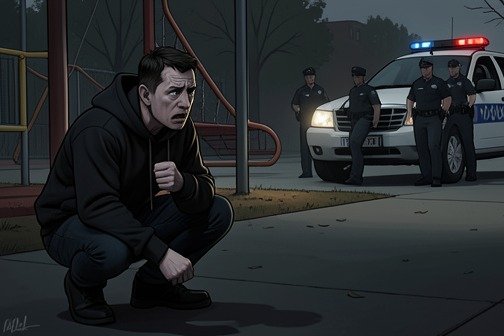
[Jacob Barber](entity:character-recall-character-jacob-barber-72f25e661d23)’s arrest is the moment the investigation’s accusation becomes a bodily fact: Jacob is handcuffed and held, but the circumstances of [Ben Rifkin](entity:character-recall-character-ben-rifkin-ee0ef547649e)’s death remain contested. [After](entity:expression-recall-expression-after-f466acd0fe53) hiding for hours around [Cold Spring Park](entity:location-recall-location-cold-spring-park-c214120d077b), nearby backyards, and the play structure behind the elementary school he had once attended, Jacob gives police one account of finding Ben’s body and then falls silent. His arrest brings his father’s fears and the case’s public logic into the same frame, while the repeated plea for his dad makes the immediate cost unmistakably personal.
## Background and the search
The arrest follows the discovery of a fingerprint associated with Jacob and the public accusation that has made him a suspect. Meanwhile, his father, [Andrew Barber](entity:character-recall-character-andrew-barber-8b47cdbff3c8), is trying to protect him before the police arrive. Andrew has been searching Jacob’s room and weighing whether to hide the laptop; he fears it might contain damaging material, but also that its disappearance would itself look suspicious given Jacob’s online presence. He leaves it where it is. The doorbell rings, and the search warrant is delivered by [Paul Duffy](entity:character-recall-character-paul-duffy-dea30aca2158), Andrew’s old friend, now among the troopers executing the search. Andrew stands mute as Duffy presses the folded warrant into his hand, then is told to wait outside. The scene collapses the distinction between a prosecutor’s former professional world and his home: the friend is still recognizable, but the warrant has made him an agent of the investigation.
The search for Jacob continues into the evening. Andrew and [Laurie](entity:character-recall-character-laurie-6a86783f9333) wait until dark, after the police and onlookers have drifted away, but Jacob does not return. He has been hiding for hours, mostly in the woods of Cold Spring Park, in backyards, and in the play structure behind the elementary school he once attended. Police find him there at around eight o’clock. The route from the park to familiar childhood surroundings gives the arrest a stark geography: a wanted adolescent has been moving through places close to home, but cannot safely go home.
## The arrest and Jacob’s statement
Jacob submits to the handcuffs without complaint and does not run. He tells the officer, “I’m the one you’re looking for” and “I didn’t do it.” When the officer challenges him about his fingerprint on Ben’s body, Jacob says he found Ben already lying there, tried to pick him up to help, saw that he was dead, and became scared and ran. It is the only statement he ever gives police. The account may sound like an explanation for the fingerprint as well as an admission that he was present; the narrative withholds certainty about whether Jacob blurted it out foolishly or deliberately shaped a defense. Andrew rejects the media’s portrait of Jacob as especially clever or cunning, but cannot settle what the statement means.
Afterward, Jacob says nothing further about the case. The only words he repeats to the officer are “I want my dad.” His silence, in contrast with that single, consequential explanation, makes the arrest both a legal turning point and an intimate scene of dependence. The boy who has just addressed the police about the body now reduces his demand to the person he wants beside him.
## Custody and family consequence
Jacob cannot be bailed that night and is held in the lockup in [Newton](entity:location-recall-location-f7ba52918bf2), only a mile or two from the family home. Andrew and Laurie are allowed a brief visit in a small, windowless room. Jacob’s eyes are watery and red-rimmed; his face is flushed, with a horizontal red mark across each cheek. He is visibly frightened, yet tries to hold himself rigid and composed, imitating an adolescent idea of manliness. Andrew sees panic, anger, and sorrow being held in check, and recognizes that Jacob cannot sustain the effort indefinitely. The arrest thus moves the family from the frantic uncertainty of the search to the physical reality of detention, without giving them either an answer or relief.
The family’s later experience makes clear that custody and eventual exoneration do not simply close the episode. Andrew recalls that life after Jacob’s release did not return to normal: the family went out little, avoided public places where they felt watched, and settled into a narrow routine at home. Andrew took over grocery shopping because Laurie feared another encounter with the Rifkins. The story’s distinction between a few decisive “[Big Days](entity:expression-recall-expression-big-days-cc43e611b723)” and the many ordinary days that follow gives Jacob’s arrest a long echo: the arrest is a momentous event, but what follows is not a clean ending. Even after the legal case changes, the family must live inside its consequences.
Event 11
Andrew Barber's grand jury investigation
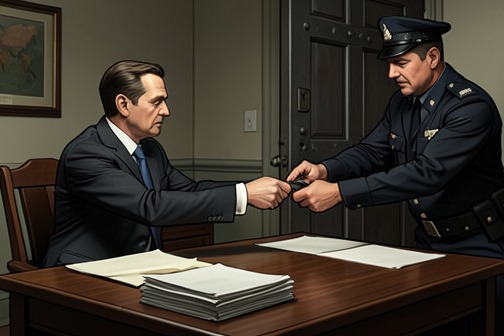
[Andrew Barber](entity:character-recall-character-andrew-barber-8b47cdbff3c8)’s grand jury investigation, convened in [April 2008](entity:time-recall-time-april-2008-f8c9b4e1ca2c), is a belated examination of both the murder accusation against his son, Jacob, and Andrew’s own decision to conceal a knife he found in Jacob’s dresser. The proceeding arrives too late to restore confidence in the investigation or give the Rifkin family the certainty it seeks. Its questions expose the gulf between legal process and personal accountability: Andrew must explain his silence, while the grand jury hears a case shaped by a prosecutor who has only one side to present.
## A delayed proceeding
The inquiry takes place more than a year after the body of fourteen-year-old [Ben Rifkin](entity:character-recall-character-ben-rifkin-ee0ef547649e) was found in [Cold Spring Park](entity:location-recall-location-cold-spring-park-c214120d077b). By the time [Neal Logiudice](entity:character-recall-character-neal-logiudice-18b620d30e1e) subpoenas Andrew in April 2008, the evidence has grown stale and tainted, and the case has already damaged Logiudice’s professional standing. Andrew believes the delay has come too late not only for the prosecution but for Logiudice’s career. He regards the proceeding as a moment when the case’s accumulated failures can no longer be separated from the question of what happened.
The grand jury itself is presented as a weary group of roughly thirty men and women, seated in cramped school chairs with small desks attached. Its members have served long enough to understand the routine: identify someone to accuse. There is no judge and no defense lawyer in the room; the prosecutor controls the presentation. In theory, the grand jury checks prosecutorial power by deciding whether the evidence warrants an indictment and a trial. In practice, no-bills are rare, and indictments common, because jurors ordinarily hear only the prosecution’s side. Andrew suspects that these jurors recognize Logiudice has no viable case left to make.
## The knife and Andrew’s testimony
The proceeding turns on Andrew’s failure to report a knife he discovered during the investigation. Logiudice asks whether Andrew reported finding it; Andrew says he did not. The prosecutor frames that omission as especially damaging because Andrew had spoken earlier in support of the legal system. He presses the implication that Andrew’s conduct amounted to treating Jacob as guilty: Andrew found the suspected murder weapon, concealed it, and did not tell investigators.
Andrew rejects that characterization, but the facts give the accusation force. He also did not join the volunteer search of Cold Spring Park for the missing knife. At the search, Logiudice’s theory is that Andrew stayed away because he already knew the effort could not find a knife he had found in Jacob’s dresser and disposed of. The testimony therefore makes Andrew’s loyalty to his son inseparable from his obstruction of a search that the community believed might resolve the case. The investigation scrutinizes not just what he knew, but what his choices did to the public effort to establish what happened.
## Two families and the demand for closure
The grand jury’s delay is measured against the Rifkins’ continuing need for an answer. [Dan Rifkin](entity:character-recall-character-dan-rifkin-fccce31db74f) asks why the killer acted, insisting that his questions are not about procedural details but about the reason behind the death. He also wants to know what helps bereaved parents endure and whether resolving a case can ease their suffering. Andrew offers the practical advice that survivors rely on family, other people, and support groups rather than trying to manage grief alone.
Dan then makes clear what resolution means to him: he expects the case to end with the responsible person locked away, and he hopes that certainty will bring closure to his wife and family. Andrew reassures him that resolution can help, while recognizing the pressure in Dan’s appeal. He wants to help and, at the same time, wants to get away from the pain Dan brings into the conversation. The exchange makes the procedural stakes intimate: a charge or a dismissal is not only a decision about evidence but also the answer a bereaved family has been waiting for.
That divide is visible when the Barbers and Rifkins meet at a market. [Joan Rifkin](entity:character-recall-character-joan-rifkin-eaad79497e95) appears beside Dan, and the two parents face Andrew, [Laurie](entity:character-recall-character-laurie-6a86783f9333), and Jacob. The imbalance is stark: one family has three people present, the other two, and one son remains alive while the Rifkins’ son is gone. No one needs to say aloud what Jacob’s continued existence represents to them. The encounter shows why a legal outcome cannot distribute consolation evenly: Jacob’s survival is relief for his parents and an unbearable contrast for Ben’s.
## The prosecution’s story and its limits
The case presented in court is built around a story of a boy who supposedly “snapped.” Logiudice describes Ben’s death, casts Jacob as an isolated teenager teased by a more popular classmate, and invites jurors to understand ordinary school provocation as the trigger for lethal violence. His method follows a deliberate principle of trial persuasion: facts alone are not enough; the prosecutor must give jurors a story that answers what the case is about and a theme they can carry into deliberations.
But Logiudice cannot supply a convincing explanation for how an apparently nonviolent boy could commit such a brutal act. He can offer theories about what Ben might have said or done and speculate about “murder genes,” but Andrew recognizes these as guesses filling a central hole in the prosecution’s account. The grand jury episode and the courtroom story together expose the difference between constructing a persuasive narrative and establishing what happened. The prosecutor’s authority to tell the story does not make its missing motive any less missing.
## Resolution without restoration
The investigation’s eventual context sharpens the contrast between legal proof and emotional certainty. When [Leonard Patz](entity:character-recall-character-leonard-patz-efe0f3e856b7) confesses, Andrew experiences the news as more than the possibility of a jury’s not-guilty verdict: he believes Jacob has been proven innocent. Yet the family waits to celebrate until the case is formally dismissed. Logiudice files a nolle prosequi before the judge takes the bench, and the judge then tells Jacob he is a free man. The charges end without a jury verdict, and the family’s immediate joy does not undo what the investigation has done to them.
Nor does the dismissal resolve the Rifkins’ grief. As the Barbers leave the courthouse, Dan approaches with a kitchen knife, but Father O’Leary intervenes before Dan reaches them and disarms him. The attempted attack makes the unresolved conflict between the families newly dangerous, even after the state has ended its case against Jacob.
The book’s account of life after the dismissal resists the idea that a decisive day can conclude a story. Andrew describes lives as mostly ordinary days punctuated by a handful of consequential ones, and Jacob’s exoneration is one such day. But the family does not return to normal: they avoid public places where they expect to be watched, and Andrew takes over grocery shopping because Laurie will not risk another encounter with the Rifkins. The grand jury’s delayed questioning thus belongs to a larger reckoning that produces legal consequences without repairing trust, grief, or the damage done to ordinary life.
Event 12
Andrew Barber's disclosure of his family history to Laurie
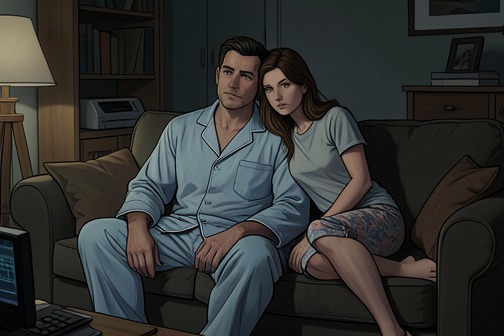
[Andrew Barber's disclosure of his family history to Laurie](entity:event-recall-event-andrew-barber-s-disclos-c090001faf87) is a late-night confession that turns a private family secret into a question about trust, identity, and what Andrew's history might mean for Jacob. He recounts the violence in his ancestry and argues that it does not define him; [Laurie](entity:character-recall-character-laurie-6a86783f9333)’s response makes clear that the harm lies not only in the history itself but in his having withheld it from the person he married and raised a child with.
## The moment of disclosure
The conversation comes after a punishing day, but Andrew is still awake at two in the morning, slumped in the living room and unable to get himself to bed. Laurie comes downstairs barefoot, in pajama bottoms and a threadbare turquoise T-shirt, and urges him to come to bed because nothing more can be done that night. Instead, he asks her to sit and says there is something he has to tell her, something that will soon come out. When she asks whether it is about Jacob, Andrew says it is about himself.
The delay and the hour matter: Andrew has carried the story for thirty-four years, yet tells it in five or ten minutes, after the day’s pressures have left him stranded on the couch. His announcement turns the conversation from the immediate case to the history he has kept apart from their shared life. He presents the telling as necessary before that history becomes public, but also as a way to relieve a burden he has borne alone.
## The family history he recounts
Andrew describes a sequence of violent episodes in the Barber family. He names [James Burkett](entity:character-recall-character-james-burkett-fd4e17a21b7a) as the first “bloody Barber,” a figure who came east from the frontier, and recalls that his grandfather, Rusty Barber, was a war hero who later killed a man in a fight over a traffic accident in [Lowell, Massachusetts](entity:location-recall-location-lowell-massachusetts-2acf1d3b1100). He then tells Laurie about his father, Bloody [Billy Barber](entity:character-recall-character-billy-barber-fb023c82ecd3), whose violent past involved a young girl and a knife in an abandoned building.
Andrew’s account moves across generations, but he does not claim that the events are identical or explain them through a single cause. What connects them in the scene is his recognition that he comes from this family history, and his insistence that inheritance is not the same as identity. Having finished the brief account, he says that this is what he comes from; he has kept the facts private for decades because he believed they did not determine who he was.
## Laurie’s response and the breach of trust
Laurie listens with a blank, disappointed expression and asks why Andrew never told her. He answers that the history did not matter and that he is not like the men who came before him. Laurie’s objection is not simply that the family has a violent past: she says Andrew should have trusted her to understand, and that she had a right to know whom she was marrying and having a child with. Andrew counters that she did know him because she married him, and that the history has nothing to do with their life together. Their disagreement is therefore about what knowledge marriage requires, as much as about whether the past defines the present.
For a moment, Andrew believes they might survive the argument and move on. He kneels in front of Laurie, rests his arms on her lap, and asks her to believe that he is not his father or grandfather. Laurie says she does believe him, though uncertainly, and that she is too tired to continue. Andrew presses her to look at him and remember the person she has known since they were seventeen. But he also recognizes that he has asked her to absorb a family secret in the middle of the night, following one of the worst days of her life, partly to ease his own mind.
## A marriage recast by memory
The confession prompts Andrew to reconsider the story he has told himself about his marriage. He remembers Laurie as a young woman he met at seventeen, and describes their life together, their family, and their home as gifts she gave him. For thirty-four years, he says, the spell of that idealized memory lasted. Now, at fifty-one, he sees Laurie not as the shining girl preserved in his recollection, but as a woman exhausted by the present crisis. The change in his perception does not erase his love for her; it exposes how memory can hold a person in an earlier image even as a shared life becomes more difficult.
The scene also makes the secret’s timing consequential. Andrew frames the confession as disclosure before the story comes out, but Laurie experiences it as information withheld from her throughout the marriage. His appeal—that he remains the same person she has known—cannot settle the question she raises: whether she had a right to know the family history before they built a life and had Jacob together.
## Consequences within the family crisis
The disclosure resonates beyond this one exchange because Jacob’s case has made violence within the Barber family newly difficult to regard as distant history. Later, Laurie wonders whether she and Andrew made mistakes raising Jacob, and Andrew rejects the suggestion that his childhood behavior signaled anything serious. During the trial, Laurie sits alone in the courtroom, separated from the support Andrew thinks her parents could offer. [After](entity:expression-recall-expression-after-f466acd0fe53) hearing [Dr. Vogel](entity:character-recall-character-dr-vogel-2b8a17ee10dd)’s diagnosis, she asks Andrew what they should do if Jacob is guilty; his attempt to comfort her only leads her to withdraw further. The family secret thus sits alongside, rather than resolves, the parents’ conflicting fears about their son.
Laurie’s later question sharpens the stakes: if Jacob is acquitted and commits another act of violence, she asks, would they bear responsibility? Andrew tells her to stop thinking that way and postpones the conversation, while Laurie insists they need to be honest with each other. The exchange echoes the earlier confession: what Andrew has treated as history he could keep to himself, Laurie treats as knowledge a family may need in order to face uncertainty responsibly.
The marriage does not return to its earlier sense of certainty. Andrew’s disclosure briefly allows him to ask Laurie for reassurance that he is separate from the violence in his ancestry, but it also reveals the cost of having left her outside that history. The scene’s lasting tension is not a verdict about whether blood determines character. It is the unresolved distance between Andrew’s claim that the past has nothing to do with them and Laurie’s insistence that, because they are parents and partners, they must be able to speak honestly about what they do not know.
Event 13
Ben Rifkin murder case
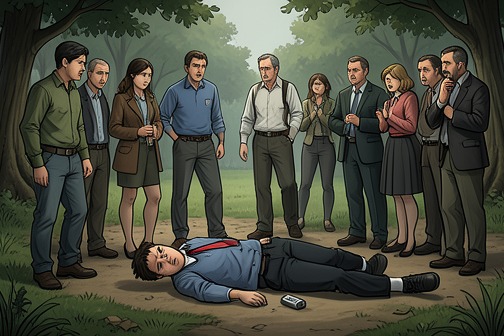
The [Ben Rifkin murder case](entity:event-recall-event-ben-rifkin-94575c815d46) is the investigation and prosecution of the killing of fourteen-year-old [Ben Rifkin](entity:character-recall-character-ben-rifkin-ee0ef547649e) in [Cold Spring Park](entity:location-recall-location-cold-spring-park-c214120d077b), a crime that turns an ordinary school morning into a contest over who can make the most persuasive account of incomplete evidence. [Jacob Barber](entity:character-recall-character-jacob-barber-72f25e661d23), Ben’s classmate, is charged with first-degree murder. But the case never reduces to a single uncontested explanation: a knife, a story posted online, and accounts of Jacob’s conduct acquire different meanings as investigators, lawyers, and witnesses arrange them into rival narratives.
## The Killing and the Initial Case
The prosecution’s opening account places Ben’s death early on a spring morning, after he had left home for school. In its telling, he was found in Cold Spring Park, less than a quarter mile from both the school he was walking toward and the home he had just left. Prosecutor [Neal Logiudice](entity:character-recall-character-neal-logiudice-18b620d30e1e) emphasized that Ben was fourteen and that the killing had happened quickly, presenting the abruptness of the act as a question the jury needed to answer rather than a sufficient explanation in itself.
The trial’s competing descriptions of the case reflect a deeper evidentiary problem: motive and identity cannot simply be read off the fact of the killing. The narrative acknowledges that jurors want to understand why a crime occurred, while Logiudice has no definite trigger to offer. He can suggest that Ben may have teased, insulted, or bullied Jacob, but these possibilities remain conjectural. The gap between a clear account of what happened to Ben and an uncertain account of why it happened becomes one of the prosecution’s central difficulties.
## Jacob Barber and the Prosecution’s Story
Jacob is brought into court from lockup to face one count of first-degree murder. He sees his family in the courtroom and lowers his eyes; in a suit selected by [Laurie](entity:character-recall-character-laurie-6a86783f9333) and delivered by defense lawyer [Jonathan Klein](entity:character-recall-character-jonathan-klein-24d9eee6e9d8), he fusses with the coat and tie. His awkwardness and fear are later vulnerable to public interpretation: reporters describe his fidgeting as vanity, while his father understands it as the discomfort of a frightened boy unused to formal clothes. The scene establishes how quickly demeanor, like physical evidence, can be turned into an argument about character.
Logiudice offers the jury a sharply organized account of Jacob as an outsider among his classmates, a boy with a lethal temper who killed after being pushed too far. He casts Ben as popular and admired, but cautions that the victim need not be made into a saint: Ben could tease others and still be an ordinary fourteen-year-old whose life had scarcely begun. This concession helps the prosecution’s story seem less like a simple division between a perfect victim and a monstrous defendant. Its decisive claim is that Jacob had a murder plan and needed only a trigger; yet when Logiudice cannot identify that trigger, the proposed explanation depends on probability rather than a demonstrated motive.
The trial presents the prosecution’s work as a deliberate act of storytelling. Logiudice is described as shaping a concise theme for the jury, returning to the phrase that Jacob had “snapped.” Andrew recognizes the effectiveness of this technique even while rejecting its conclusion. In the case’s courtroom world, facts do not speak without arrangement: a repeated phrase can make scattered details feel like a coherent causal chain, while the missing link—the reason Jacob supposedly acted—remains exposed beneath the polish.
## The Knife and the Online Story
The knife becomes a crucial part of the suspicion surrounding Jacob. In testimony, [Derek Yoo](entity:character-recall-character-derek-yoo-64a9030f135a) recalls that Jacob had shown him a combat-style knife and had once brought it to school. Derek also says he came to feel that Jacob had probably killed Ben once it became known that Ben had been stabbed in Cold Spring Park. His account distinguishes what he personally knew from the inference he drew: the knife was something he had seen, while Jacob’s guilt was a conclusion formed after the crime’s basic details circulated.
A story titled “A Walk in the Woods,” posted on the Cutting Room, gives the suspicion a more troubling form. It describes a fictionalized killing in a renamed park and town, with a character recognizable as Ben under another name. Andrew finds the story saved among the favorite stories of a user called “Job”; the author and uploader fields are blank. He suspects Jacob wrote it, but admits that the available details cannot establish authorship. The story’s voice and its familiarity with Cold Spring Park raise questions, yet the possibility that Jacob merely read it does not prove that he committed the murder.
The story’s evidentiary force changes as the case proceeds. Andrew regards its account of the knife wounds’ angle as a detail that would not have been public and, to him, a clincher: he believes the specificity amounts to a written confession and says it supplies probable cause to arrest Jacob. In later testimony, however, he acknowledges that the story is what persuaded him, while the defense challenges whether its details were actually secret. Derek says the knife, the park, and the three wounds were already widely known. Thus the same text can appear to Andrew as privileged knowledge and to the defense as material assembled from public information. The unresolved questions of who wrote it and when its details became available prevent the story from settling the case on its own.
## Rival Narratives and the Limits of the Evidence
Andrew’s account of investigative reasoning is also an account of its danger. He explains that investigators facing incomplete data form a theory and then search for evidence that supports it, sometimes ceasing to notice evidence pointing elsewhere. When Neal Logiudice names [Leonard Patz](entity:character-recall-character-leonard-patz-efe0f3e856b7) as an example of an alternative suspect Andrew had pursued, Andrew agrees. He believes Patz actually killed Ben, but recognizes, in retrospect, that his conviction that Jacob did not do it had become entangled with his belief that Patz did. The counternarrative may be true, yet the process of choosing it can still resemble the very confirmation bias Andrew criticizes.
That alternative story shapes the defense’s strategy. Andrew thinks the jury will want an answer to the question of who killed Ben if Jacob did not, and that merely attacking the prosecution’s proof may leave that question unanswered. He therefore favors presenting Patz as a competing suspect. His account openly acknowledges the emotional and logical complication: he is Jacob’s father, and his belief in Patz is joined to his belief in his son. The case makes that entanglement part of the evidence’s human context, not a reason to treat Andrew’s conclusion as established fact.
The case is framed through forms of testimony and documentation as well as through courtroom argument. Andrew’s grand-jury appearance begins with the formal request for his name; later, a message directs him to a newly created [Facebook](entity:organization-recall-organization-facebook-72fee13d0373) group about Ben, and the trial examines a letter from [Dr. Vogel](entity:character-recall-character-dr-vogel-2b8a17ee10dd) to Klein. These records give events the appearance of an official or documentary order, but they do not eliminate interpretation. A message can direct attention, a letter can be entered as an exhibit, and a witness can describe what he believed; none by itself resolves who killed Ben. The accumulation of records makes the investigation legible while repeatedly showing how much depends on what a reader or investigator infers from them.
## Meaning and Continuing Uncertainty
The killing changes the lives and roles of those drawn into the case: Jacob stands accused, Ben becomes the absent center of a public argument, and his classmates’ memories and suspicions become part of the effort to explain the crime. The prosecution seeks a motive and a character portrait capable of binding the evidence together; the defense contests the adequacy of that account and presses an alternative. The distinction between what a witness saw, what became common knowledge, and what someone later inferred remains essential to judging each claim.
The murder case’s decisive significance lies in the distance between proof and narrative. The details of Ben’s death are made concrete in court, but the identity and motive attributed to the killer remain disputed through the evidence presented here. Jacob’s knife, the online story, and the proposed involvement of Leonard Patz do not function as self-interpreting answers. Each becomes part of a story whose persuasiveness must be distinguished from what it actually establishes.
Event 14
Jacob Barber's arraignment
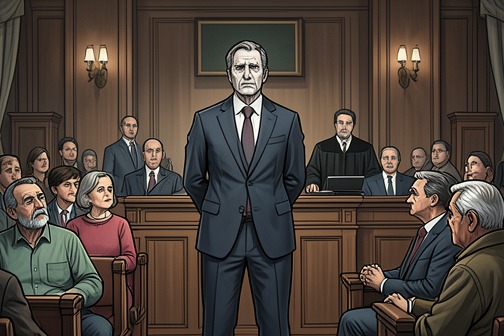
[Jacob Barber's arraignment](entity:event-recall-event-4a25c1f9824a) turns his murder charge into a public courtroom event, establishing both the immediate terms of his release and the competing stories that will shape the trial. The hearing leaves him facing one count of first-degree murder, but sets bail at $10,000, rejects the prosecution's objection to his lawyer, and sends the case to Judge French. Outside the courthouse, reporters crowd the family, making clear that the case is already being tried before an audience beyond the courtroom.
## The Hearing and Its Public Stage
The arraignment takes place in Courtroom 6B, where an extra jury box has been fitted with a television camera broadcasting a shared video feed to local stations. While the family waits, the camera remains trained on them. [Andrew Barber](entity:character-recall-character-andrew-barber-8b47cdbff3c8) notices his large, pale hands and scuffed knuckles, feeling the strangeness of being watched in a courtroom that had once been as familiar to him as his own kitchen. The room has changed from a workplace he knew to a stage on which his own family is being scrutinized.
When the clerk calls the case, Jacob is brought from the lockup by two court officers and made to stand before the jury box. He sees his parents, then lowers his eyes and fidgets with the suit and tie [Laurie](entity:character-recall-character-laurie-6a86783f9333) has chosen and [Jonathan Klein](entity:character-recall-character-jonathan-klein-24d9eee6e9d8) has delivered. The coat is already too small for him. Andrew reads the boy's discomfort as fear and awkwardness, not the vanity reporters will later attribute to his fidgeting. Klein joins him at the defense table and places a hand on his back, a visible declaration of support: he is willing to stand beside his young client rather than treat him as someone to avoid.
## Bail and the Dispute over Counsel
[Neal Logiudice](entity:character-recall-character-neal-logiudice-18b620d30e1e) asks for bail of $500,000 cash or $5 million surety. He argues that Jacob poses a flight risk because of the crime's severity, the likelihood of conviction, and the sophistication he supposedly acquired in a home where criminal law was the family business. Andrew hears the reference to himself as more than a routine argument. He suspects Logiudice has chosen the line deliberately, using their former closeness and Andrew's family history to strengthen the prosecution's public framing of Jacob.
Judge Rivera sets bail at the $10,000 level that has applied since Jacob's arrest. Her decision treats the requested increase as unwarranted: Jacob has nowhere to run, and his family is known to the court. Logiudice's argument fails, but he immediately contests Klein's appearance as counsel, alleging that Klein had represented another suspect in the homicide and might possess confidential information relevant to Jacob's defense.
Klein answers that he had not been retained by that person in this case and had never discussed the homicide with him. His earlier involvement had been limited to advising the man, who called him while being questioned at the [Newton](entity:location-recall-location-f7ba52918bf2) police station, not to answer questions. Rivera overrules the Commonwealth's objection and warns Logiudice not to get carried away. The ruling allows Jacob to keep the lawyer of his choice, though Andrew observes that the accusation may still gain traction in the public debate over whether the defense is acting in good faith.
## From Courtroom to Street
Rivera assigns the case to Judge French for trial and recesses. The bail arrangements are completed quickly, and Jacob is released to his parents. Their exit from the courthouse is not a private return to family life: a larger and more aggressive crowd of reporters waits outside. On Thorndike Street, someone pushes Jacob in the chest, apparently trying to provoke a reaction. Jacob gives none, keeping his expression blank as the family moves through the press.
Reporters also ask what happened inside, despite the courtroom's live video feed and the messages their colleagues have sent them. The question exposes the hearing's double function: it is a legal proceeding, but also public material to be replayed, interpreted, and turned into a story. Andrew and Laurie take Jacob home exhausted. Laurie, already losing weight since the catastrophe began, looks increasingly drawn; when the family reaches the driveway, she notices graffiti on the front of their house. The pressure surrounding the case has followed them from the courtroom to their home.
## The Stories the Trial Must Test
The arraignment's immediate legal decisions are only the beginning of the case's struggle over meaning. At the later trial, Logiudice presents the prosecution's account as a story with a compressed theme: Jacob had a lethal temper and, when provoked, suddenly snapped. His opening frame draws on the image of fourteen-year-old [Ben Rifkin](entity:character-recall-character-ben-rifkin-ee0ef547649e) found dead in [Cold Spring Park](entity:location-recall-location-cold-spring-park-c214120d077b), then connects the killing to alleged teasing and Jacob's isolation among classmates. It is a persuasive narrative design, but the narrator notes the gap between a vivid account of the crime and a proven explanation of why it happened.
Logiudice acknowledges that the trigger may never be known and offers possible insults or bullying as theories rather than established answers. Andrew emphasizes that a motive is not legally required in the same way as proof of the charge, yet jurors want a comprehensible account of what happened. The prosecution's use of a ready-made story therefore carries a tension: a memorable theme can organize evidence for an audience, but cannot by itself close the evidentiary gap. The arraignment begins that contest before the trial proper, while the camera, the press, and the family home show how far its consequences already extend.
## Narrative Form and Significance
The episode is presented within Andrew's first-person recollection, which combines courtroom observation with hindsight about how the hearing was interpreted. That perspective distinguishes what he saw—Jacob's lowered eyes, the camera, the reporters—from what he infers about Logiudice's intentions and the likely effect of the lawyer's accusation. The proceedings thus arrive not as a neutral transcript alone, but as a remembered scene in which legal rulings, personal history, and public performance overlap.
The arraignment establishes the practical conditions of Jacob's pretrial freedom while exposing the fragility of that freedom in public life. He leaves custody on modest bail, retains his chosen counsel, and is assigned a trial judge; at the same time, he is pushed in front of reporters and followed home by hostility. The episode's decisive turn is not a verdict but the opening of a prolonged public argument: whether Jacob is to be understood through the prosecution's story of a boy who snapped, or through evidence that has yet to be tested.
Event 15
Andy reveals the family history to Jacob
Andy’s disclosure of his family history to Jacob is a turning point in the Barber family’s discussion of violence: what had been concealed as Andy’s past becomes, in Jacob’s eyes, a possible part of his own identity. The revelation comes during a conversation about whether Jacob could have inherited a violent tendency, and it exposes not only the family history but also the cost of Andy’s long silence. The scene leaves the family with no simple answer about inheritance, but with a newly visible breach of trust between father and son.
## The question of inherited violence
The disclosure occurs as the family considers the defense’s investigation of genetic factors. [Laurie](entity:character-recall-character-laurie-6a86783f9333) interrupts the discussion with an apprehensive question: what if the authorities or experts say Jacob inherited something like a disease? When asked what she means, she answers, “Violence.” Jacob reacts with alarm. Laurie then explains that her husband has not necessarily told the others that there is a history of violence in “our family,” deliberately including herself in the family she names. Andy notices that plural and clings to it, but the wording does not keep the revelation from landing on him.
[Jonathan](entity:character-recall-character-jonathan-c07ebc6c5e21), the family’s lawyer, asks whose father and grandfather are meant. Laurie answers, “Mine.” Her disclosure makes Andy’s history relevant to the case at precisely the moment when the family is trying to understand whether Jacob’s alleged violence could be explained, or even predicted, through inheritance. Jonathan rejects the idea that the family history establishes a genetic tendency and says that Andy’s own good nature and life argue against such a conclusion. That reassurance addresses the evidentiary argument, but it cannot undo the fact that Jacob is hearing about his father’s past in the room.
## Andy’s admission and Jacob’s response
Andy initially struggles to speak directly to Jacob. When Jacob demands to know what is going on, Andy says, “My father is in prison. He has been for a long time.” Jacob objects that he had been told his father never knew his own father. Andy qualifies that earlier account: he did not really know his father, he says, but he knew who he was. The distinction may describe Andy’s experience, but to Jacob it sounds like a concealed truth. He asks, “You lied to me?” Andy answers that he did not tell him the whole truth; Jacob repeats that it was a lie.
The exchange makes the disclosure more than a family-history briefing. Andy had wanted to move past the past rather than make it part of family life, but Jacob counters that “it’s who I am” and insists that he had a right to know. The disagreement is over both the information itself and who has the authority to decide whether it belongs to Jacob’s understanding of himself. Andy’s protective silence, from Jacob’s perspective, has deprived him of knowledge that might matter to his identity and to the case now bearing down on him.
## The family’s competing interpretations
Laurie tries to steady the conversation by asking Jacob to consider his father’s position, but Jacob turns her earlier concern back on her: “Mom, you’re the one who said it: I have the murder gene.” Laurie denies having said that. Jacob answers that she implied it. The phrase gives a name to the fear animating the scene, even as the adults resist treating it as an established fact. Jacob has heard a question about family history as a possible verdict about what he might be.
Andy says that nothing is in Jacob, but Jacob responds that Andy knows exactly how he feels and understands why Andy kept the history from everyone. His accusation shifts the focus from whether a violent tendency can be inherited to why Andy concealed the past for so long. The discussion closes without resolving either issue: Jacob leans back, folds his hands over his stomach, and withdraws from the subject. Andy lets it drop rather than trying to persuade him with a general appeal to human potential. In Andy’s later account, Jacob has seized on the idea of a “murder gene” and does not let it go.
## Consequences beyond the disclosure
The revelation gains force from the family’s circumstances. Jacob is facing a murder accusation, so a history of violence can seem to him not merely like old family information but like evidence about the person he might be. The same history also unsettles Andy’s role as a father: in front of Jacob and Jonathan, his effort to protect his son from the past is exposed as an omission that Jacob experiences as betrayal. The scene therefore joins the legal question of what can count as evidence to the intimate question of what a child has a right to know about his family.
The wider story repeatedly places private grief beside the demands of public resolution. [Dan Rifkin](entity:character-recall-character-dan-rifkin-fccce31db74f) tells Andy that uncertainty is draining and that resolving the case would help him and his family; at [Cold Spring Park](entity:location-recall-location-cold-spring-park-c214120d077b), Andy remembers Dan crossing the empty playing fields alone, bowed under the weight of his loss. These moments give the family disclosure a broader context: the case presses every family to seek an explanation, but an explanation does not necessarily settle what violence means or repair what it has damaged. Later, Jacob’s case is dismissed after [Leonard Patz](entity:character-recall-character-leonard-patz-efe0f3e856b7)’s confession, and the family initially experiences the news as vindication. Yet the story’s account of the days after that release stresses that life does not return to normal, and that a decisive legal outcome cannot simply erase the accumulated consequences.
## Narrative significance
The scene turns on a delayed telling. Andy’s family history has existed all along, but the reader and Jacob encounter its relevance when the possibility of inherited violence is explicitly raised. The disclosure does not prove that Jacob has inherited a propensity, and Jonathan specifically rejects that inference. Instead, the story shows how quickly a family secret can become a framework through which a frightened teenager interprets himself, especially when a criminal accusation has already made identity and responsibility inseparable in the family’s conversation.
That tension echoes the prosecution’s need to give the case a coherent story. In court, [Neal Logiudice](entity:character-recall-character-neal-logiudice-18b620d30e1e) presents Jacob as a boy with a lethal temper who “snapped,” while the narrative points out that the prosecution lacks a definitive answer to the question of motive and can offer only theories and guesses. Against that demand for a single explanatory account, Andy’s disclosure supplies a real family history but not a conclusive explanation of Jacob’s conduct. Its decisive consequence is relational rather than forensic: the silence between father and son has been broken, but the truth arrives entangled with shame, fear, and Jacob’s sense that the past may define him.
Event 16
Jacob's defense psychiatric evaluation interview
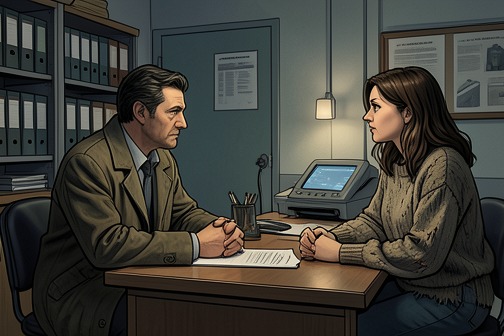
[Jacob's defense psychiatric evaluation interview](entity:event-recall-event-7db9c9b81d2e) brings the Barber family to [McLean Hospital](entity:organization-recall-organization-mclean-hospital-bf788f4b5e90), where defense psychiatrist [Dr. Elizabeth Vogel](entity:character-recall-character-dr-elizabeth-vogel-9387a7c2d7d4) asks about Jacob's childhood and behavior. The meetings are intended to assess competency and criminal responsibility, but they also become a test of what the family can acknowledge: [Laurie](entity:character-recall-character-laurie-6a86783f9333) recounts troubling patterns, Andrew tries to defend his son from their implications, and Vogel insists that the assessment requires candor rather than advocacy. The interview does not resolve whether Jacob killed [Ben Rifkin](entity:character-recall-character-ben-rifkin-ee0ef547649e); it makes the family’s competing understandings of him part of the case itself.
## Purpose and Setting
The evaluation begins as a standard defense procedure proposed by Jacob’s lawyer, [Jonathan Klein](entity:character-recall-character-jonathan-klein-24d9eee6e9d8): a competency and criminal responsibility assessment. Andrew learns that the selected psychiatrist is also an authority on genetic inheritance and behavior, and worries that the defense may have to address the contested idea of a “murder gene.” He regards such evidence as scientifically immature and fears that it could become propensity reasoning: an argument that Jacob was disposed to violence and therefore committed this crime. Klein’s preparation thus opens a subject Andrew would rather keep outside the case.
The meetings take place in a bare, sparsely furnished room on the campus of McLean Hospital, where Dr. Elizabeth Vogel practices. The plain setting offers little of the comfort Laurie hopes to find in the psychiatrist. Vogel, who also teaches and researches at Harvard Medical School, does not simply listen passively; she leans forward and presses for frank answers. Her manner makes the interview less a reassuring consultation than a structured effort to obtain a fuller account of Jacob.
## Laurie’s Recollections
Laurie describes noticing Jacob’s moods when he was very young. As a baby, she says, she could recognize from the sound of his crawling that he was entering a frightening mood. During such episodes, he would come down the hall on all fours, throw things, and scream. Laurie says she could not stop the outbursts, and would put him in his crib or playpen and step away until he calmed down.
She dates the beginning of other children being hurt around Jacob to when he was two. Laurie does not describe him simply as mean; she says he seemed unable to imagine how other children would feel if he pushed them down and was hard to control. At the time, she and Andrew treated the behavior as a phase that many boys passed through. Laurie had asked Jacob’s pediatrician for help and was told not to worry, that he was still very young and would outgrow it. The reassurance left her feeling that her concern might be excessive, even as she remained horrified when other children were hurt.
Laurie says the situation improved in some respects: other children were no longer getting hurt around Jacob. But she adds that he continued to misbehave, especially by stealing. She remembers him taking things from stores, a CVS, the library, and her purse, and says that talking to him did not change the behavior. These recollections complicate a simple account of an entirely untroubled childhood without establishing that any childhood behavior caused the murder.
## Conflict Within the Family
The interview makes Laurie’s willingness to speak and Andrew’s resistance to her disclosures collide. Andrew objects that she is being unfair to Jacob, while Laurie insists that she is telling the truth. Her account threatens the defense’s cleanest emotional claim—that the family can confidently separate an ordinary childhood from the accusation now confronting them. Andrew hears the conversation as treating Jacob as someone who must answer for something; Laurie appears determined not to let his objections silence her.
Vogel asks Laurie directly whether she doubts Jacob’s innocence. Laurie answers no, but Vogel observes that her descriptions sound as though she may have doubts. The question does not produce an admission of guilt. Instead, it exposes a distinction the family struggles to maintain: concern about Jacob’s past is not itself proof that he committed the crime, yet the pressure to defend him makes even an account of childhood behavior feel dangerous.
Andrew eventually interrupts the direction of the discussion. He insists that Jacob had nothing to do with Ben Rifkin’s death and objects to treating him as a freak or monster. He calls Jacob an ordinary boy with flaws, and frames the injuries from early childhood as rough play that ended before kindergarten. His defense is both a statement of belief and an effort to prevent the interview from turning personal history into a theory of criminal responsibility.
## Confidentiality and the Unresolved Record
Vogel tells the family that she has been hired by the defense, works for them, and is on Jacob’s side. She explains that she will submit her report to Klein, after which the family can decide what to do with it, and says their conversation is confidential. She asks them not to hide information or defend Jacob in the room; her stated aim is to learn the truth about him. Andrew remains uneasy with the premise that anyone can confidently claim to know that truth.
That unease gives the evaluation its lasting significance. The family has invited an expert to assess Jacob, but the resulting account cannot be kept neatly separate from the legal battle: childhood behavior may be interpreted as relevant to a psychiatric evaluation, or recast as a prosecution narrative about violent disposition. The interviews therefore reveal both the need for a fuller record and the danger of making that record do more than it can prove. The questions sharpen the conflict between protection and candor, but the evidence presented here supplies no definitive verdict about Jacob’s innocence or guilt.
Event 17
Jonathan Klein questions Jacob
[Jonathan Klein questions Jacob](entity:event-recall-event-1c4c77606774) Barber in a defense meeting about the events surrounding [Ben Rifkin](entity:character-recall-character-ben-rifkin-ee0ef547649e)’s death. The interview turns Jacob’s account into a test of credibility: Klein probes what Jacob noticed, what he did afterward, and how his explanation might sound under cross-examination. The exchange unsettles Jacob and [Laurie](entity:character-recall-character-laurie-6a86783f9333), and helps establish the defense’s practical dilemma: Jacob should not testify, but merely attacking the prosecution’s case may not be enough.
## Purpose and Setting
The episode appears under the chapter heading “Questioning” and centers on Klein’s interview with Jacob about the knife and the discovery of Ben’s body. The meeting is not presented as a hostile police interrogation; Klein asks in a measured, curious manner, while steadily examining details that could trouble a jury. His role is both supportive and adversarial in a limited sense: he represents Jacob, but cannot simply accept an account that may fail under courtroom scrutiny.
The interview takes place with Laurie present. She remains silent through much of the questioning, then intervenes when Klein’s method begins to distress Jacob. Her intervention changes the tone of the meeting, but not its underlying purpose: the defense must assess the story as jurors and the prosecutor may hear it, rather than only as Jacob remembers or intends it.
## The Account Under Examination
Klein asks whether Ben’s body was on the path Jacob usually took through the park, and whether Jacob saw or heard anything before finding him. Jacob says he had not thought about the path in that way and recalls simply walking until he saw Ben lying there. Klein then focuses on Jacob’s failure to use the cell phone in his pocket to call emergency services. The question draws attention to a gap between the gravity of the situation and Jacob’s reported response.
Klein also tests what Jacob noticed at the scene. He points to the blood trail down the hill and asks whether Jacob saw it. Jacob says he did not, explaining that he was frightened and internally panicking, though he did not show that reaction when [Derek Yoo](entity:character-recall-character-derek-yoo-64a9030f135a) encountered him a few minutes later. Klein gathers these details into a single challenge: Jacob says he was overwhelmed, saw no blood, and did not understand what had happened, even though the circumstances described in the interview make those claims difficult to accept at face value.
The questioning becomes more personal when Jacob tells Klein that the lawyer’s phrasing makes it sound as if Jacob is lying. Jacob insists that the account is his own, while objecting that Klein has distorted its details. In particular, he rejects the picture Klein has constructed of Ben lying entirely facedown amid an overwhelming amount of blood. The scene thus distinguishes between Jacob’s insistence on truthfulness and the precision, coherence, and plausibility that a courtroom will demand from his story.
## The Limits of Testimony
Klein warns Jacob that an account that sounded convincing when rehearsed alone may sound different under cross-examination. He contrasts the present interview with the more aggressive questioning he expects from [Neal Logiudice](entity:character-recall-character-neal-logiudice-18b620d30e1e), the prosecutor. The warning is tactical rather than a declaration that Jacob is lying: Klein says his responsibility is to prepare the defense, not to act as Jacob’s parent, and he tests the account before the prosecution can do so.
The exchange over the thumbprint sharpens the problem. Klein asks the jury’s question in effect: how could Jacob place a thumbprint inside Ben’s sweatshirt, beneath the body, and then withdraw his arm without visible blood on it? Jacob responds that Klein has got the details wrong, but continues to maintain that the story is true. The interview therefore leaves a central difficulty unresolved: Jacob’s confidence in his account does not itself resolve the apparent mismatch between its details and the evidence Klein describes.
When Jacob asks how he will testify at trial, his father, [Andrew Barber](entity:character-recall-character-andrew-barber-8b47cdbff3c8), tells him he will not take the stand. Klein agrees that this is wise. Jacob immediately asks what his defense will be, and Klein explains that the defense has no burden to prove anything; its task is to challenge the prosecution’s case at every turn. Andrew, however, doubts that this alone will suffice, given the thumbprint and the witness who places a knife in Jacob’s hand.
## Alternative Theory and Consequence
Andrew proposes that the jury should hear about [Leonard Patz](entity:character-recall-character-leonard-patz-efe0f3e856b7) and calls him the real killer. Klein’s response is practical: the defense must establish how it can prove that claim. Andrew suggests hiring a detective to investigate. The proposal follows directly from the interview’s impasse. Jacob’s testimony appears too vulnerable to cross-examination, and a purely negative defense seems inadequate to Andrew, so the conversation turns toward an alternative suspect and the need for evidence to support that theory.
The encounter does not produce a new, settled account of Ben’s death. Instead, it clarifies the choices and risks facing the defense: Jacob’s story must withstand hostile scrutiny, he is advised not to testify, and the defense must decide whether to rely on weaknesses in the prosecution’s case or investigate a positive alternative. Laurie’s request that Klein stop shows the personal cost of that preparation, while Jacob’s continued insistence that he is telling the truth leaves the factual conflict open rather than resolving it.
Event 18
Matt McGrath reveals Leonard Patz leads to Andy
Matt Magrath’s disclosure gives [Andrew Barber](entity:character-recall-character-andrew-barber-8b47cdbff3c8) a possible alternative suspect in [Ben Rifkin](entity:character-recall-character-ben-rifkin-ee0ef547649e)’s murder, tying [Leonard Patz](entity:character-recall-character-leonard-patz-efe0f3e856b7) to Ben before the killing and to a knife. The lead arrives through a witness who admits he lied about an earlier allegation against Patz and had threatened to report him in order to obtain money. Magrath’s testimony therefore changes the direction of Andrew’s inquiry without offering the clean certainty the case demands.
## The approach to Magrath
Andrew seeks to ask about Leonard Patz, but Magrath first recognizes him as a former employee of the [District Attorney’s Office](entity:organization-recall-organization-district-attorne-62fb646c424c) and asks whether he has seen the file. Andrew confirms that he has. The conversation takes place against the background of an earlier report Magrath made about Patz. Magrath says the conduct he reported never happened; when Andrew asks why he made the report, Magrath says the explanation is complicated.
Magrath then identifies Andrew as [Jacob Barber](entity:character-recall-character-jacob-barber-72f25e661d23)’s father and tells him that Jacob did not commit the murder: Patz did. The assertion is direct, but it is not yet evidence of what happened in the park. Andrew has to learn why Magrath connects Patz to the crime, and why he withheld the information until now.
## A compromised history
Magrath explains that he and Patz had been friends, in a qualified and uneasy sense. Patz had paid him over a period of several weeks. When Patz wanted to stop paying, Magrath threatened to report him, knowing Patz was on probation and listed as a sex offender, and that a probation violation could send him back to prison. Magrath says Patz paid some of the money but resisted paying the full amount. He describes his own need for money and his willingness to use the threat of a report to get it.
That account undermines Magrath’s credibility even as it clarifies the context of his earlier accusation. He admits that the alleged incident behind the report did not occur and that his financial dispute with Patz shaped what he told authorities. Andrew is not receiving a confession from a disinterested witness: Magrath has lied before, has a personal grievance, and knows that his account may be discounted for precisely those reasons.
## The lead concerning Ben
Magrath says Patz ended their arrangement because he was interested in another boy, someone who walked through [Cold Spring Park](entity:location-recall-location-cold-spring-park-c214120d077b) in the morning near Patz’s apartment. Magrath identifies that boy as Ben. Before the murder, he says, Patz had talked about trying to meet the child, whom he had identified by name after hearing Ben’s friends speak of him. Patz described Ben as beautiful. In Magrath’s account, this was not a connection invented after the killing: Patz had discussed finding Ben before Ben was murdered.
Magrath also says Patz carried a knife when he thought he might meet someone. He had seen Patz with the knife on the day they met. Magrath does not say that he witnessed Patz encounter Ben, attack him, or go to the park on the day of the murder. The lead is therefore specific but incomplete: it supplies prior interest in Ben and a reported weapon, not direct observation of the crime.
## Why the revelation was delayed
Asked why he had not spoken sooner, Magrath says he expected nobody to believe him. Because he had already lied about the earlier incident, he feared that any later truthful account would be rejected as another fabrication. His hesitation makes his silence understandable within the history he describes, but it also leaves investigators and readers with a familiar evidentiary problem: the witness may be telling the truth now, yet his own conduct gives others strong reason to doubt him.
The episode sharpens the distinction between a lead and proof. Magrath’s information offers Andrew a plausible route toward Patz, grounded in Patz’s reported prior attention to Ben and his possession of a knife. At the same time, the source of that information is compromised by a false accusation and a money dispute. The disclosure advances the search for an alternative explanation while preserving the uncertainty that surrounds the case.
Event 19
安迪与沃格尔讨论行为遗传学取样
The discussion between [Andrew Barber](entity:character-recall-character-andrew-barber-8b47cdbff3c8) and [Dr. Elizabeth Vogel](entity:character-recall-character-dr-elizabeth-vogel-9387a7c2d7d4) about behavioral-genetics testing begins as preparation for [Jacob Barber](entity:character-recall-character-jacob-barber-72f25e661d23)’s defense and becomes a confrontation with the Barber family’s history. Vogel proposes taking DNA samples from Andrew and his estranged father, William Barber, to investigate genetic factors that might be relevant to the case. Her explanation makes the evidence double-edged: it could support a prosecution story about inherited violence, or help the defense argue for mitigation. The session ends not with certainty about what a test could prove, but with Andrew agreeing to face a family history he had kept at a distance for decades.
## A New Question in the Defense
Near the end of summer, Andrew and [Laurie](entity:character-recall-character-laurie-6a86783f9333) attend their weekly meeting with Vogel. Before the session properly begins, Vogel warns Andrew that the hour will be difficult, then explains that the discussion concerns the case’s biological issues and that she needs a DNA sample from him. She describes the procedure as a quick swab of the mouth, using a sterile cotton swab to collect saliva. The ordinary simplicity of the proposed test contrasts with the weight Andrew immediately attaches to it: he thought the genetic question had been set aside.
Vogel does not present the sample as a straightforward route to an answer. She tells Andrew she cannot determine what would be admissible in court; that is a legal question for him and Jacob’s attorney, [Jonathan Klein](entity:character-recall-character-jonathan-klein-24d9eee6e9d8). Her role is to explain how behavioral genetics might figure in the defense’s preparation. She stresses that the evidence cuts both ways. The prosecution might use it to suggest that Jacob is violent by nature, making it more likely that he committed the murder. The defense, if the case reached a point where the prosecution had likely proved that Jacob killed [Ben Rifkin](entity:character-recall-character-ben-rifkin-ee0ef547649e), might instead introduce genetic evidence as mitigation.
The distinction unsettles Laurie, who asks what mitigation means. Andrew explains the possible legal difference between first-degree homicide and second-degree homicide or manslaughter. He describes first-degree murder as carrying mandatory life without parole, while a second-degree conviction would make Jacob eligible for parole after twenty years, at age thirty-four. The discussion is not a prediction that Jacob will be convicted; it is a glimpse of the fallback calculations the defense may have to make if the case turns against him.
## Predisposition, Not Destiny
Andrew explains the legal logic that makes the issue consequential. Criminal law, as he describes it, presumes intentional acts to be products of free will and is generally resistant to excuses based on hardship, illness, intoxication, or anger. Such circumstances can nonetheless matter to how a crime is classified and to sentencing. In theory, factors affecting free will—including a genetic predisposition to violence or low impulse control—might therefore be relevant as mitigation. Andrew doubts that a jury would accept such an argument, especially in a case involving the killing of a fourteen-year-old boy.
His resistance is also personal. Andrew protests that he has never hurt anyone, has no temper, and did not grow up in a violent home. He recalls that his mother did not let him play football and that, as a boy, he played the clarinet while his friends played football. Laurie places her hand over his, a gesture that calms him and matters precisely because such gestures between them have become less common.
Vogel answers Andrew’s fear of genetic determinism by separating predisposition from identity. Genes, she says, do not act alone: behavior emerges through the interaction of nature and nurture, and the same genetic sequence can have different outcomes in different people and environments. Andrew’s own life, in her view, demonstrates the importance of individual agency. She cautions against treating an emerging science as a simple explanation of behavior, and says that a genetic finding would not, by itself, tell them who Andrew is.
## What the Tests Might Examine
When Andrew asks what Vogel is looking for in his saliva, she first emphasizes the limits of the science. Human behavior has complex causes; there is no simple genetic trigger for a particular behavior, and the meaning of “criminal” is legal rather than scientific. She then identifies two gene variants associated with male antisocial behavior that might be relevant to multigenerational patterns of violence in families like the Barbers’.
The first is an allele of the MAOA gene, which controls an enzyme involved in metabolizing neurotransmitters including serotonin, norepinephrine, and dopamine. Vogel explains that it has been called the “warrior gene” because of its association with aggressive behavior, and that the mutation is known as MAOA Knockout. It had previously been argued in court as a trigger for violence, but that argument was rejected as too simplistic. Vogel says understanding of gene-environment interaction has since improved, potentially making a more careful account possible.
The second variant is in the serotonin transporter gene, SLC6A4, located on chromosome 17. Vogel describes it as encoding a protein involved in the serotonin transporter system and the reuptake of serotonin from the synapse into the neuron. The technical explanation becomes too much for Andrew, who raises his hand to stop her. The exchange underscores the gap between the intricacy of the proposed biological evidence and the legal demand to make it legible as part of a case.
## The Father’s Sample and Andrew’s Choice
Vogel then adds that she also needs a sample from Andrew’s father. Andrew says he has not spoken to him since he was five and does not know whether he is alive. Vogel tells him that William Barber is alive and is being held at [Northern Correctional Institution](entity:location-recall-location-northern-correctiona-c2f4978557af) in Somers, Connecticut. She has already tried to contact him, but William will not meet with her; he says Andrew himself has to ask.
The news unsettles Andrew not only because his father is alive, but because Vogel has already reached out to him. Andrew had treated that relationship as closed history. Vogel’s actions reveal that she regards it as a live part of the present inquiry: obtaining William’s sample could help investigate the possibility of a multigenerational pattern, while contacting him forces Andrew to approach a father he has not seen since early childhood.
Andrew initially balks at the idea of disclosing the defense’s plans to the district attorney. Laurie brings the question back to Jacob, asking how far Andrew would go for their son. Andrew says he would go to hell and back; Laurie’s reply makes clear that, for her, this means he must proceed. The testing discussion thus changes from a scientific proposal into a choice about parental responsibility, family estrangement, and the risks of using genetic evidence in a criminal defense.
## The Case’s Competing Stories
The later courtroom argument shows why the proposed research matters, without resolving what any genetic test could establish. [Neal Logiudice](entity:character-recall-character-neal-logiudice-18b620d30e1e) presents the murder as a story of a boy with a lethal temper who “snapped” after being teased. He emphasizes that Jacob took a knife into [Cold Spring Park](entity:location-recall-location-cold-spring-park-c214120d077b) and had an idea in his head, while acknowledging that the trigger for the killing may never be known. The prosecution’s need to supply a motive exposes the uncertainty at the center of its account; Logiudice can offer theories and probabilities, including “murder genes,” but not a definitive explanation.
That courtroom language echoes the danger Vogel identified in the therapy room: a genetic predisposition could be made to sound like proof of an innate, fixed identity. Her account insists on a more complicated relation between biology and conduct, while the prosecution’s narrative risks collapsing predisposition into character and character into guilt. The proposed samples therefore matter not as a simple answer to whether Jacob committed the crime, but as evidence that either side might try to enlist in its account of who he is and how responsibility should be understood.
The session does not settle the family’s genetic history or Andrew’s estrangement from William. Instead, it opens both questions at once. By agreeing to go forward, Andrew accepts that the defense may have to examine the history he has treated as past, even as Vogel cautions that no genetic sequence can stand in for a person’s whole life or determine what that person will do.
Event 20
Derek Yoo reveals Jacob's hidden side to Andy
[Derek Yoo](entity:character-recall-character-derek-yoo-64a9030f135a)’s disclosure to [Andrew Barber](entity:character-recall-character-andrew-barber-8b47cdbff3c8) becomes a turning point in Andrew’s effort to understand [Jacob Barber](entity:character-recall-character-jacob-barber-72f25e661d23): a conversation sought as help for a friend instead exposes a hidden history of cruelty and unsettling behavior. Derek’s account does not prove Jacob committed murder, but it gives Andrew reasons to question how well he knows his son—and leaves the friendship between the boys looking like something already past.
## The visit and its purpose
Andrew goes to the Yoo family home around ten in the morning during a week when Derek’s working parents are away. Derek and Jacob have continued texting and speaking by phone, though only when Derek’s parents cannot hear. Andrew expects Derek to want to help his friend, but fears he may refuse to see him. He arrives prepared to talk his way inside, or even force his way in, and goes around the back rather than knock and risk being turned away.
The visit follows Andrew’s growing sense that he has missed what was happening in Jacob’s life. He asks Derek to sit down and tell him the truth, explaining that he wants to understand what is really going on. He presents himself as Jacob’s friend as well as his father, and urges Derek to act as a friend by helping Jacob. That appeal establishes the emotional stakes of the conversation: Andrew is not simply collecting information; he is asking a boy to stand by his son at a moment when Jacob’s other relationships are under strain.
## Bullying and the knife
Derek says that Jacob had been picked on at school by a group of students led by [Ben Rifkin](entity:character-recall-character-ben-rifkin-ee0ef547649e). The teasing centered on rumors that Jacob was gay, which Ben had made up. Derek says he did not care whether Jacob was gay and wished Jacob would simply say so if he were. His account supplies a motive for Jacob’s fear without establishing that fear as justification for anything that followed.
When Andrew asks whether the bullying explains Derek’s [Facebook](entity:organization-recall-organization-facebook-72fee13d0373) disclosure about the knife, Derek distinguishes the two matters. He says Jacob had obtained the knife because he feared Ben might someday attack or hurt him, leaving Jacob to defend himself. Andrew is surprised: he had not known about the bullying or Jacob’s fear. The revelation complicates the accusation that brought the case into public view. The knife is not presented only as a clue in a murder investigation; in Derek’s account, it had also been part of Jacob’s expectation of a future confrontation.
## What Derek says he had seen
Asked whether he believes Jacob killed Ben, Derek first allows only a tiny possibility, holding his fingers a millimeter apart to indicate the degree of doubt. Pressed to explain, he describes Jacob as different from the boy Andrew believes he knows. Derek says Jacob did not necessarily have a temper or openly get angry; instead, he could be mean to other people. He recalls racist jokes and cruel comments about girls’ bodies, and says Jacob read online stories he described as torture-focused pornography. Derek says Jacob showed him some of the material on his iPod and continued reading it.
Derek’s account moves from speech and online behavior to a remembered incident in public. While a group of boys sat together on a wall, a man using crutches passed by. Derek says Jacob laughed loudly at him and called him a freak show, while the others looked at Jacob in disapproval. Derek recalls feeling uncomfortable around Jacob when he behaved that way, and admits that the behavior could frighten him. The anecdote matters less as proof of a crime than as evidence of a side of Jacob that his closest childhood friend found difficult to reconcile with their friendship.
Derek also tells Andrew about an unexplained reference to a dog. Jacob had never had a dog, but later told Derek that he had to bury one. When Derek asked whether it had died, Jacob did not answer directly. Derek suspected something was wrong, then remembered posters put up around the area by the dog’s family, with photographs stapled to telephone poles and trees. He said nothing; eventually the family stopped posting the notices, and he tried to forget the incident. Derek’s account leaves the dog’s fate unresolved, but makes his silence and his suspicion part of the history he is finally willing to tell.
## A friendship already ending
The revelations also describe the erosion of the boys’ relationship. Derek says he and Jacob are no longer friends as they were in childhood; they are old friends, and things have changed. At times, Derek thinks Jacob may never have cared much about him, neither liking nor disliking him so much as remaining indifferent. His disclosure is therefore not a simple betrayal of an intact friendship. It comes from someone who still feels the weight of their shared past but no longer trusts the closeness it once implied.
When Andrew asks why Derek had continued to be friends with Jacob despite what he knew, Derek does not offer a full explanation. Instead, he says he had always expected Jacob would get into trouble someday, although he thought it would happen when they were grown. The remark widens the significance of the conversation: Derek’s suspicion precedes the present case, but its vague, long-held quality cannot establish what Jacob did or why. It is a friend’s retrospective judgment, not a witnessed account of the murder.
## Aftermath and narrative significance
[After](entity:expression-recall-expression-after-f466acd0fe53) they sit in silence, Andrew drives slowly through the town center. In retrospect, he understands the visit as the end of something and remembers taking a small pleasure in extending the drive, prolonging a little of what felt normal. That quiet journey contrasts with the force of what Derek has disclosed: Andrew has gone looking for information to defend and understand Jacob, and returns with a portrait that does not settle the case but makes his paternal certainty harder to sustain.
The scene brings together clues of unequal force. Derek’s account of the bullying offers context for Jacob’s fear of Ben and his possession of a knife; his reports of cruelty, disturbing reading, and the unexplained dog suggest a wider pattern but do not establish responsibility for Ben’s death. The distinction matters. The conversation changes what Andrew can plausibly ignore, while leaving the central question unanswered. In that gap between disclosure and proof, the private friendship becomes part of the case’s evidence—and a measure of how little even a childhood friend, or a father, may be able to claim about another person.
Event 21
Andy finds the “A Walk in the Woods” story and destroys Jacob's iPod
[Andy Barber](entity:character-recall-character-andy-barber-ee3af19d9caa)’s discovery of [“A Walk in the Woods”](entity:object-recall-object-a-walk-in-the-woods-25e2dad6b1e8) on [Jacob Barber](entity:character-recall-character-jacob-barber-72f25e661d23)’s iPod is a turning point in the family’s effort to defend Jacob: it offers no proof that he wrote the story, yet makes the possibility of his authorship difficult for Andy to set aside. Andy responds by arguing against the story’s evidentiary force, concealing the discovery from his family, and destroying the device he sees as both a potential source of incriminating digital records and a private portal for Jacob. The act protects and compromises at once: a father’s attempt to shield his son also removes a device that might have mattered to the defense.
## Background and Search
[After](entity:expression-recall-expression-after-f466acd0fe53) a long, silent pause with [Derek Yoo](entity:character-recall-character-derek-yoo-64a9030f135a), Andy drives home slowly, conscious that something has changed and reluctant to let the ordinary ride end. At home, he goes upstairs to Jacob’s room and finds Jacob’s iPod Touch on the bureau. Jacob had given his parents the four-digit password as a condition of keeping the device, so Andy can unlock it and open its browser.
Jacob’s bookmarks include familiar sites such as [Facebook](entity:organization-recall-organization-facebook-72fee13d0373) and Gmail, along with blogs about technology, video games, and music. The Cutting Room is absent. Andy finds the message board through a Google search instead. Its sparse, text-only pages contain stories of violence and cruelty; the limited browser does not reveal which stories Jacob read or how long he visited the site. It does establish that Jacob had an account there, under the screen name Job.
## The Saved Story
Clicking Job’s username takes Andy to a page of the account’s favorite stories. Twelve are listed, with “A Walk in the Woods” at the top. The story is dated April 19, more than three months earlier, and its author and uploader fields are blank. The account’s saved list demonstrates that the story was associated with Job’s favorites, but does not identify who wrote it.
The story follows Jason Fears, who carries a knife into the woods. It becomes a lurid, barely disguised account of [Ben Rifkin](entity:character-recall-character-ben-rifkin-ee0ef547649e)’s killing in [Cold Spring Park](entity:location-recall-location-cold-spring-park-c214120d077b): the park is renamed Rock River Park, [Newton](entity:location-recall-location-f7ba52918bf2) becomes Brooktown, and Ben is recast as a bullying character called Brent Mallis. The invented names disguise the setting without erasing the resemblance to the case.
Andy assumes Jacob may have written the story, but recognizes the limits of that assumption. Its adolescent voice and knowledge of Cold Spring Park fit what he knows of Jacob and the site; none of those features proves authorship. The most he can establish with confidence is that Jacob read the story. That distinction becomes the hinge of Andy’s response: the discovery is alarming, but it is not a confession.
## Evidence and Doubt
Andy returns to the habits of his profession, trying to minimize what he has found and defend Jacob. He notes that the story contains nothing he recognizes as information unavailable to the public. It could have been assembled from newspaper reports and imagination. Even details that sound intimate or specific had appeared in news coverage, while other particulars are unwitnessed and impossible for investigators to verify. In his reasoning, the story’s apparent proximity to the murder cannot by itself establish that its writer knew facts only the killer could know.
He also tells himself that Jacob would have understood how foolish it was to write such material, guilty or not. Jacob had previously posted a Psycho image on Facebook, but Andy struggles to believe he would go further. The pressure of the case, Jacob’s confinement at home, and the approaching trial offer Andy a way to frame the story as reckless adolescent behavior rather than evidence of murder.
That defense does not silence his reaction. The story’s account of Ben’s distress stays with him, and Andy experiences the discovery as an emotional wound even as he refuses to accept doubt as a conclusion. His roles divide without resolving: the lawyer can point to the absence of proof, while the father feels the force of what the story might mean. He continues to love and believe in Jacob, but his confidence now has to contend with an image he cannot simply reason away.
## Destruction of the iPod
Andy reads the story again, then clears it from the browser’s memory. He initially considers returning the iPod to Jacob’s bureau without telling Jacob or [Laurie Barber](entity:character-recall-character-laurie-barber-9075d91c7e89) what he found. His decision changes when he considers the device itself a risk. In his understanding, deleting browsing history cannot guarantee that internet activity has disappeared: records may remain on servers and on computers. He fears that the district attorney’s office could obtain the iPod and search it for evidence.
The device presents a second concern. Unlike the family computers, the small, phone-like iPod gives Jacob web access that Andy cannot supervise as readily, and Andy thinks Jacob treats it as a private space. He calls it a leak and a danger—not because the story proves Jacob’s guilt, but because the device could preserve traces and allow further unsupervised browsing. In the basement, Andy lays it glass-side up on his worktable, gets a hammer, and smashes it.
## Consequences and Narrative Significance
The destruction is a decisive action, but it does not settle what the story means. Andy has found grounds for fear, not certainty; he destroys the object while preserving the distinction between suspicion and proof in his own legal argument. The choice also leaves [Laurie](entity:character-recall-character-laurie-6a86783f9333) and Jacob unaware of what he discovered, at least at this point in the episode. Instead of confronting Jacob or sharing the discovery, Andy privately removes the device he believes could put him at risk.
The scene’s tension lies in the gap between interpretation and evidence. The saved story is strongly tied to Jacob’s account, but its blank authorship fields and its dependence on publicly reported material prevent Andy from treating it as an admission. The iPod itself becomes more than a tool: once it holds a possible connection between Jacob and the murder, its ordinary usefulness gives way to its perceived danger. Andy’s hammer ends the immediate possibility of examining the device, while leaving the central question—whether Jacob wrote the story—unanswered.
Event 22
Jacob Barber indicted for Ben Rifkin's murder
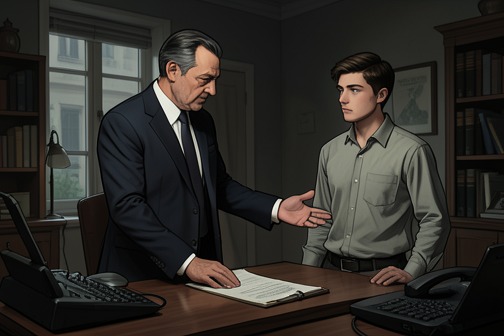
[Jacob Barber](entity:character-recall-character-jacob-barber-72f25e661d23)’s indictment for [Ben Rifkin](entity:character-recall-character-ben-rifkin-ee0ef547649e)’s murder marks the point at which an investigation becomes a public case—and a contest over how its evidence will be made to mean. Investigators say that interviews with Ben’s classmates uncovered a bullying conflict, and that information attributed to Jacob’s friend [Derek Yoo](entity:character-recall-character-derek-yoo-64a9030f135a) added a possible motive, a knife, and blood on Jacob’s hand. At trial, [Neal Logiudice](entity:character-recall-character-neal-logiudice-18b620d30e1e) turns those claims into a story of sudden violence, while the first-person account stresses that the central question of why remains unresolved.
## Background and Investigative Basis
The case against Jacob takes shape after investigators interview children at [McCormick School](entity:location-recall-location-mccormick-school-dd4f0c514ec5). The students are not forthcoming at first, but the interviews eventually reveal what the investigator describes as an ongoing conflict between Ben and Jacob, with Ben bullying Jacob. The account says this led investigators to begin considering Jacob as a suspect. It also notes that some aspects of the investigation were conducted without [Andrew Barber](entity:character-recall-character-andrew-barber-8b47cdbff3c8)’s knowledge, even as Andrew’s role in the case made that secrecy consequential.
The evidence later attributed to Derek Yoo gives the suspected conflict a more specific investigative shape. Investigators say Jacob had a knife consistent with the wounds, had sufficient motive, and had said he would defend himself with a knife if Ben continued bullying him. They also report that Derek said Jacob came to school that morning with a small amount of blood on his right hand. In the courtroom exchange, the account is carefully framed as information received from a friend, not as an independent finding established in that moment.
## The Prosecution’s Case Story
At trial, Logiudice presents the killing as a sequence with a clear emotional trigger. He describes Ben as a fourteen-year-old found dead in [Cold Spring Park](entity:location-recall-location-cold-spring-park-c214120d077b), and argues that Jacob had a knife and an idea in mind when he left home for the park on [April 12, 2007](entity:time-recall-time-april-12-2007-db09c2cef9f7). In this telling, the remaining question is what made Jacob act. Logiudice proposes teasing or bullying as the spark and repeatedly frames the alleged act as a temper that “snapped.”
The prosecutor’s account also gives each boy a contrasting social role: Ben is described as handsome, popular, and admired, while Jacob is cast as quiet, lonely, and an outsider among classmates. Logiudice acknowledges that Ben was not perfect and that he teased Jacob, but argues that such ordinary school behavior could not justify the killing. The structure is persuasive by design: a recognizable conflict is made to lead toward a dramatic, decisive break. Andrew, watching the presentation, recognizes the skill of the technique even as he considers Logiudice’s explanation unfounded.
## The Unanswered Question of Motive
The narrative makes the weakness in that causal story explicit. Motive may not be a formal element of every case, Andrew reflects, but jurors want an intelligible reason for a crime. Logiudice offers possibilities—names Ben may have used, or some form of pushing, threatening, or bullying—and admits that the exact trigger may never be known. Andrew’s immediate response to the prosecutor’s reliance on probability underscores the gap between a plausible courtroom narrative and a demonstrated explanation.
That gap matters because the prosecution’s theme supplies coherence where the evidence, as presented here, does not settle the cause. The case is not only about whether particular pieces of evidence point toward Jacob; it is also about whether the story joining them can answer why. The phrase [“The defendant snapped”](entity:expression-recall-expression-the-defendant-snap-4c010b08fc60) compresses a complex and uncertain question into a memorable verdict-like theme before the jury has completed its work.
## Trial and Documentary Framing
The book places the case inside several forms of record and retelling. It opens with Andrew identifying himself as a witness in a grand-jury proceeding, later includes courtroom exchanges about a document from [Dr. Vogel](entity:character-recall-character-dr-vogel-2b8a17ee10dd) to defense lawyer [Jonathan Klein](entity:character-recall-character-jonathan-klein-24d9eee6e9d8), and follows Andrew’s retrospective account of the trial. These materials give the proceedings an archival texture, but they do not make every account equally conclusive: questions, testimony, reported statements, and Andrew’s interpretation remain distinct kinds of evidence.
That distinction becomes especially important when the judge denies the defense motion for a mistrial after Logiudice mentions Jacob’s grandfather. The judge records the objection, says the issue is preserved for appeal, and instructs the prosecutor not to raise it again; the trial then continues. The ruling shows the case proceeding despite a disputed reference, while the formal record preserves the challenge rather than resolving its significance.
## Consequences and Significance
The indictment’s larger consequence is to place Jacob’s life and identity under competing interpretations. The prosecution presents the alleged bullying, the reported knife and blood, and the supposed threat as parts of one causal account. Andrew’s narration, by contrast, repeatedly distinguishes what investigators report from what those facts can actually explain. The tension between evidence and story remains central even as the trial advances.
The event is therefore significant not simply as a procedural step, but as the beginning of a struggle over narrative authority. In court, a concise theme can make uncertain evidence feel inevitable; in Andrew’s account, the unresolved motive keeps that certainty under pressure. The proceedings move forward, but the question at their center—what, if anything, turned the conflict into murder—remains open in the evidence presented here.
Event 23
雅各布·巴伯谋杀案审判
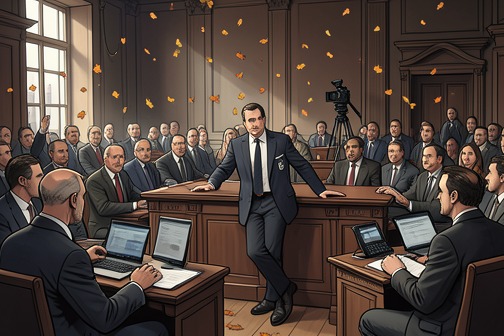
[Jacob Barber's murder trial](entity:action-recall-action-jacob-barber-s-murder-58f452a2c989) is the central legal contest over whether Jacob killed [Ben Rifkin](entity:character-recall-character-ben-rifkin-ee0ef547649e), and a struggle over who gets to make the killing intelligible. Beginning in mid-October 2007, the proceedings turn on the prosecution's story of a boy who “snapped,” a defense confronting gaps in motive and proof, and families for whom a court's resolution cannot undo loss. The case ends without a jury verdict: after [Leonard Patz](entity:character-recall-character-leonard-patz-efe0f3e856b7) confesses, the state drops the charges and Jacob is declared free. Legal vindication brings a decisive change in status, not a return to the life the Barbers had before the trial.
## Background and Opening
By the eve of trial, [Andrew Barber](entity:character-recall-character-andrew-barber-8b47cdbff3c8) felt energized and certain of victory, a confidence he later recognized as detached from reality. The trial began in mid-October, during the last brilliant stretch of autumn leaves. Its first morning was delayed by arrangements for the pool camera, whose feed was to be shared with news stations, and by the organization of the unusually large jury pool. The ceremonial start arrived only after the crowded courtroom had waited past nine o’clock.
When the case was called, Jacob crossed the bar with his lawyer, [Jonathan Klein](entity:character-recall-character-jonathan-klein-24d9eee6e9d8), and took his place at the defense table. His parents had put their hands on his back during the court’s opening ceremony. That small gesture began a repeated tableau: Jacob at the defense table, Andrew beside the proceedings, and [Laurie](entity:character-recall-character-laurie-6a86783f9333) watching from the front row. The case would occupy the courtroom for two weeks, while the Barbers’ family life was narrowed to the trial and its consequences.
The trial’s emotional stakes were not confined to the accused and the victim. [Dan Rifkin](entity:character-recall-character-dan-rifkin-fccce31db74f) had earlier told Andrew that he wanted to understand why the killer acted, beyond the details of evidence and procedure. The uncertainty was draining, he said, and he hoped that resolution would bring his family closure. At [Cold Spring Park](entity:location-recall-location-cold-spring-park-c214120d077b), Andrew remembered seeing Dan cross an empty playing field alone, a small figure moving against the vast green space. The image connects the legal search for an answer to the private experience of bereavement: for Dan, a case resolved was also a hoped-for end to uncertainty.
## The Prosecution’s Story
In his opening, [Neal Logiudice](entity:character-recall-character-neal-logiudice-18b620d30e1e) gave the jury a compact, forceful account of the crime. He described a fourteen-year-old boy found dead at Cold Spring Park, near the school he had been walking toward and the home he had left minutes earlier. He then turned from the victim’s death to the defendant’s supposed character and motive: Jacob, he argued, had been teased, had a lethal temper, and finally “snapped.” The repeated phrase was designed to make a complicated case legible as a sudden, decisive eruption.
Logiudice framed the victim, Ben Rifkin, as an ordinary teenager rather than a flawless ideal. The jury, he said, would hear that Ben had teased Jacob, but the teasing was not extraordinary; Ben was a fourteen-year-old with ordinary flaws and years of life ahead of him. In contrast, the prosecution described Jacob as quiet, lonely, sensitive, and odd, an outsider who wanted to be like the more popular Ben. This characterization arranged the boys into a story of social contrast and gave the alleged killing a personal context.
The prosecution also promised a causal sequence: Jacob left home for Cold Spring Park with a knife and an idea, and some later provocation supplied the trigger. But Logiudice acknowledged that the precise trigger might never be known. He offered possibilities about insults or bullying, then uncertainty. Andrew saw the difficulty in this account: motive was not itself a legal element, but jurors wanted an explanation for an act that otherwise seemed inexplicable. The opening thus exposed a tension within the prosecution’s own narrative. Its memorable theme was certainty and suddenness; its explanation of why the act occurred remained conjectural.
## Grief, Family, and the Courtroom
The trial placed both families in the public view, but not on equal terms. Laurie spent the proceedings in the front row, staring at the back of Jacob’s head. Andrew described her as pale and thin among the spectators, enduring the case as a physical ordeal. Parents of young defendants, he reflected, were expected to attend silently while being treated as both victims and perpetrators: pitied for their misfortune, blamed for raising the accused, and mistrusted for supporting him. The courtroom could hear the case against Jacob, but it could not give his parents an uncomplicated social position.
The consequences of the accusation also followed the families outside court. At a market encounter, Andrew saw Dan and [Joan Rifkin](entity:character-recall-character-joan-rifkin-eaad79497e95) with Jacob present. Joan’s glare and the awkward silence made the imbalance plain to him: three members of one family stood facing two members of another, with one son still there and the other gone. Andrew understood that Jacob’s continued presence could appear offensive in the immediate shadow of Ben’s death. The scene does not resolve the families’ opposing claims; it shows how the fact of survival itself had become charged.
Dan’s hope that a conviction or other resolution would relieve his family is set against Andrew’s awareness that grief cannot be managed as a legal timetable. Dan asked what helped bereaved parents endure and whether some never recovered. Andrew pointed him toward family, other survivors, and support groups, while admitting the impulse to help sat beside a wish to escape Dan’s visible pain. The trial’s promised closure therefore had two meanings: a procedural outcome for the case and an imagined relief for the people living with the loss.
## Outcome and Aftermath
On the fifth day of trial, Judge French denied Jacob’s motion for a mistrial after the prosecution mentioned Jacob’s grandfather. The judge said the objection was preserved for appeal, that he had given a curative instruction, and that the issue would not be discussed further. The ruling kept the trial moving, but it also recorded a boundary crossed in front of the jury and left the dispute available for later review.
The decisive reversal came when Leonard Patz confessed. Andrew and Laurie received the news before reaching the courthouse and woke Jacob to share it. Andrew experienced the confession as more than the possibility of a not-guilty verdict: to him, it seemed to prove Jacob innocent. Yet the family did not treat their relief as official until the case was formally dismissed. Before the judge took the bench, Logiudice filed a nolle prosequi, withdrawing the state’s charges; Jonathan Klein therefore had no occasion to move for dismissal.
The judge then asked Jacob to stand and announced that he was a free man. The courtroom responded with a cheer, and Jacob and Andrew embraced. The ending was legally clear but emotionally unsettled. Andrew later described the day as a Big Day, one of the few momentous dates by which people organize their lives, yet ordinary days continued afterward. The Barbers did not return to normal: they avoided public places where they felt watched, Andrew took over the grocery shopping, and Laurie avoided the market because she feared another encounter with the Rifkins. The charges were gone; the families’ grief, the public hostility, and the damage to ordinary routines remained.
## Narrative and Legal Significance
The trial is presented not only as a sequence of testimony and rulings but as a contest in storytelling. Logiudice explicitly understood that facts alone would not answer the jury’s question of what the case was about. His phrase [“The defendant snapped”](entity:expression-recall-expression-the-defendant-snap-4c010b08fc60) compressed character, motive, and action into a repeatable theme. Andrew, himself a former prosecutor, recognizes the craft of the performance even as he rejects the weakness of its explanation. The gap between a memorable narrative and what the evidence can establish becomes part of the trial’s meaning.
That gap matters because the final result does not come from a jury weighing the prosecution’s story against the defense and returning a verdict. Patz’s confession changes the course of the case, and the state dismisses its charges before the jury decides Jacob’s guilt. The outcome frees Jacob from prosecution, but it does not make the trial a complete instrument of truth or repair. The narrative closes the courtroom case while showing why its human consequences continue: a formal end can settle legal status without restoring trust, resolving bereavement, or making life before the accusation recoverable.
Event 24
Abandonment of the investigation into Leonard Patz
The abandonment of the investigation into [Leonard Patz](entity:character-recall-character-leonard-patz-efe0f3e856b7) was a consequential narrowing of the inquiry into [Ben Rifkin](entity:character-recall-character-ben-rifkin-ee0ef547649e)’s murder: once [Jacob Barber](entity:character-recall-character-jacob-barber-72f25e661d23) was selected for indictment, investigators stopped seriously pursuing another suspect whom the available evidence had not excluded. At trial, the defense used the decision to challenge both the completeness of the investigation and the confident story the prosecution told the jury about motive and guilt.
## Background and decision
The record presented at trial established that the Patz investigation had not been ruled out by evidence. Lieutenant [Paul Duffy](entity:character-recall-character-paul-duffy-dea30aca2158) agreed that there was no evidence at the time that excluded Leonard Patz as a suspect, and no evidence had subsequently emerged that directly cleared him. The distinction mattered: the investigation was not dropped because a definitive finding had eliminated Patz.
Duffy testified that the inquiry into Patz was stopped once the decision was made to indict Jacob. He identified District Attorney [Lynn Canavan](entity:character-recall-character-lynn-canavan-b05bc0579d0c) as the person who made that decision and said she had been advised by [Neal Logiudice](entity:character-recall-character-neal-logiudice-18b620d30e1e). Asked whether Logiudice had pushed for dropping the Patz angle in a discussion among investigators, the district attorney, and Logiudice, Duffy ultimately acknowledged that he had. The sequence connected the investigative turn to a prosecutorial choice: the alternative was set aside as the case against Jacob advanced.
## The alternative suspect and the defense challenge
The defense’s questioning made the unpursued lead relevant to more than procedural history. Duffy agreed that [Andy Barber](entity:character-recall-character-andy-barber-ee3af19d9caa) continued to believe Patz was the real killer, and that this belief was unsurprising given the limited information available at the time. He also confirmed that he himself had first brought Patz to Andy’s attention. The line of inquiry therefore exposed a tension between the early breadth of the investigation and its later concentration on Jacob.
The questioning did not establish that Patz committed the murder. Instead, it established the narrower but important fact that investigators had neither excluded him nor produced evidence directly clearing him, while the investigation was no longer seriously pursuing him. Duffy’s account located the choice to stop within a group discussion but also identified Logiudice’s advocacy as part of how that choice was made. The abandoned lead thus became a question about investigative judgment and the limits of what the prosecution could claim to have resolved.
## Competing stories of the crime
That unresolved alternative stood against the prosecution’s effort to supply the jury with a coherent motive. In his opening, Logiudice framed the case around a fourteen-year-old victim, Ben Rifkin, and argued that Jacob had a lethal temper that finally “snapped” after ordinary teasing. He acknowledged that Ben had teased Jacob and that the jury would hear unflattering things about the victim, while insisting that Ben was an ordinary boy whose imperfections did not make his death deserved.
Logiudice’s own account revealed the gap the defense could press: he described the trigger as something the prosecution might never know, then offered possibilities—an insult, a push, a threat, or bullying—rather than a demonstrated cause. The narration observes that a jury wants to understand why, and that a crime without a clear motive is difficult to prove. The abandoned Patz inquiry sharpened that uncertainty. The prosecution presented a story in which Jacob’s temper turned teasing into murder, while the investigation had left an alternative suspect uncleared and the motive itself partly conjectural.
## Significance and unresolved consequences
The Patz decision illustrates how the definition of a case can change as investigators and prosecutors settle on a defendant. Logiudice’s opening argument treats the jury’s task as one of story-making: facts must be arranged into an account of what the case is about. The later testimony about Patz unsettles that account, not by proving an alternative culprit, but by showing that an investigative possibility had been dropped before evidence resolved it.
The book preserves the difference between legal accusation and certainty. Andy’s continuing belief in Patz is reported alongside Duffy’s testimony that Jacob had not been the object of Andy’s suspicions, while the trial record establishes no direct proof that Patz was responsible. The investigation’s abandonment therefore remains consequential without becoming a solution: it exposes a choice made under uncertainty and leaves the reader with the distance between a persuasive courtroom narrative and a fully settled truth.
Event 25
MAOA Knockout testing of the Barber family
The [MAOA Knockout testing of the Barber family](entity:event-recall-event-maoa-knockout-73c8d9a72a5c) begins as a defense investigation into a possible biological predisposition and becomes a test of what a family can bear to know about itself. [Andrew Barber](entity:character-recall-character-andrew-barber-8b47cdbff3c8) seeks a sample from his estranged father, William “Billy” Barber, so that the family’s genetic results can be compared. When [Laurie](entity:character-recall-character-laurie-6a86783f9333) later learns in court that Billy, Andrew, and [Jacob Barber](entity:character-recall-character-jacob-barber-72f25e661d23) all have the mutation, the finding does not prove that Jacob committed murder or that the mutation made him violent; it gives Laurie’s fear of inherited violence a concrete, three-generation shape.
## Purpose and Family Background
The test belongs to the defense effort to investigate whether the [MAOA Knockout mutation](entity:state-recall-state-maoa-knockout-mutation-e47385d880da) might contribute to aggression under certain environmental conditions. Andrew explains the proposed link to Billy as a possible biological predisposition, not a direct explanation of behavior. The question is therefore broader than Jacob’s case: if the mutation appears in successive generations, what can that pattern tell the family about risk, inheritance, and responsibility?
The request also brings Andrew back into contact with a father he has long kept at a distance. Billy offers help because Jacob is his grandson, but Andrew has already decided not to put him on the witness stand, judging him a poor liar. The genetic sample gives Billy a way to assist the defense without becoming a trial witness, while placing Andrew in the difficult position of asking a prisoner and estranged parent for bodily evidence.
## Collecting Billy’s Sample
Andrew arrives with a sterile swab and a plastic envelope, then tells Billy that he needs a DNA sample to test for MAOA Knockout. Billy asks what the mutation is; Andrew describes it as a genetic change that researchers think may code the body to be more aggressive in certain environments. Billy’s blunt questions and Andrew’s explanation turn an abstract theory into a practical request: the defense needs Billy’s DNA to investigate whether the mutation runs through the Barber family.
The collection is constrained by prison rules. At [Northern Correctional Institution](entity:location-recall-location-northern-correctiona-c2f4978557af), Andrew cannot personally swab Billy’s mouth. That would have provided the cleanest chain of custody, since Andrew could testify that the swab had remained in his possession, but the prison’s no-contact restriction bars it. [After](entity:expression-recall-expression-after-f466acd0fe53) negotiating with staff and speaking to the deputy warden, Andrew is permitted to pass the kit through a guard instead.
From the visiting booth, Andrew talks Billy through each step. Billy must open the package, swallow, rub the long cotton swab along the inside of his cheek near the back of his mouth, place it in the plastic container without touching the tip to anything else, seal it, and sign and date the label. Andrew must watch throughout so Billy does not block his view. With his hands still cuffed, Billy tears open the paper wrapper, first puts the swab in his mouth like a lollipop and pretends to bite it, then wipes it against his upper gums and inside his cheek. He holds the stick up to the window. The sample is obtained, but the elaborate instructions make clear how much the test depends on preserving the identity and handling of one small object.
## The Result in Court
The test’s significance sharpens when Laurie questions [Dr. Vogel](entity:character-recall-character-dr-vogel-2b8a17ee10dd) during Jacob’s trial. She asks whether Jacob has the mutation and presses for a direct answer rather than another explanation of predisposition. Dr. Vogel says yes. Laurie then asks whether Andrew has it and whether her father-in-law has it. Dr. Vogel answers yes to both: the mutation is present in Jacob, Andrew, and Billy.
The sequence converts a qualified scientific idea into a visible family pattern. The result does not, by itself, establish that any of the three has acted violently because of the mutation, nor does it resolve Jacob’s guilt. But the repeated affirmative answers give Laurie’s fear a form that is difficult to dismiss as merely theoretical. Her questions connect the accused son, the husband beside her, and the grandfather whose DNA Andrew went to prison to collect.
## Consequences for Andrew and Laurie
The results land within a marriage already strained by the trial and by disagreement over how to understand Jacob’s childhood. Laurie recalls their early parenting as a period in which they may have been unprepared and made mistakes; Andrew resists the implication that they caused Jacob’s present crisis. As they sit together, Laurie’s hand briefly rests on her chair arm, but she withdraws it before Andrew can reach for it. The gesture makes their disagreement physical: comfort is considered, then refused.
In court, Laurie sits alone on the front bench, separated from the other people around her by an empty space. She has refused Andrew’s offer to enlist her parents to sit with her, and he understands her solitude as a way of bearing the cost of marrying into his family. The night before Dr. Vogel’s testimony, the diagnosis leaves Laurie so shaken that she asks for one of Andrew’s sleeping pills and still cannot sleep. When he tries to comfort her in bed, she moves away to the far edge. The gene’s disclosure therefore intensifies not only her fear about Jacob but also the distance between the parents trying to decide what that fear requires of them.
Laurie later asks Andrew what they should do if Jacob is acquitted and then kills again, insisting that they may have some responsibility. Andrew tells her that she is exhausted and should stop thinking that way, postponing the discussion rather than answering it. Her question remains open: a genetic result offers neither a verdict nor instructions for a family, yet it makes the prospect of future harm part of their present moral argument.
## Significance and Limits
The testing’s power lies in the gap between what the result establishes and what the family wants it to explain. It establishes that the mutation is shared by three generations of Barber men. It does not establish that the mutation is a “murder gene,” determine Jacob’s guilt, or settle whether his parents could have prevented what happened. Andrew’s earlier explanation emphasizes predisposition and environment; Laurie’s courtroom questions, by contrast, gather the positive results into a pattern of inheritance that feels like an answer even when it is not a causal proof.
That tension makes the test more consequential than a laboratory inquiry. Andrew seeks genetic information as part of Jacob’s defense, but the evidence returns to the family as a source of uncertainty and dread. The sample collected through a prison window and the three yeses in court link a practical investigation to the intimate question that the trial cannot resolve for Laurie: whether the danger she fears is already written into the family, and what responsibility follows from knowing that possibility exists.
Event 26
Laurie throws a household knife into the park pond
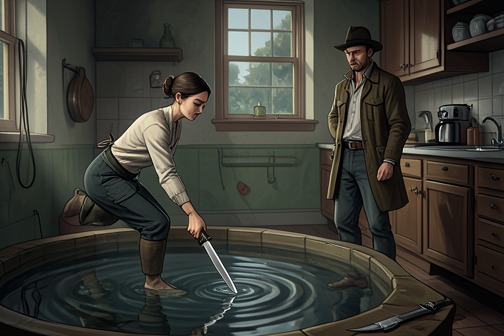
[Laurie throws a household knife into the park pond](entity:event-recall-event-7b594c159b68) in an effort to protect [Jacob Barber](entity:character-recall-character-jacob-barber-72f25e661d23) from what she and [Andrew Barber](entity:character-recall-character-andrew-barber-8b47cdbff3c8) fear will be a false inference of guilt. Recounted later under cross-examination, the act becomes more than a concealed piece of evidence: it reveals the Barbers’ willingness to manipulate an investigation in defense of their son, and Andrew’s chillingly practical response when he discovers what [Laurie](entity:character-recall-character-laurie-6a86783f9333) has done.
## The missing knife and the planted explanation
At trial, [Neal Logiudice](entity:character-recall-character-neal-logiudice-18b620d30e1e) asks Andrew about a knife thrown into a body of water to throw off investigators, and whether he knows who planted it. Andrew says he knew from the start. His knowledge comes from a specific discrepancy at home: a knife was missing from the family kitchen. The recovered knife, he explains, was not merely similar to one the family owned. [After](entity:expression-recall-expression-after-f466acd0fe53) seeing it among the state’s evidence, he recognized it as their own old, distinctive knife, one that did not match the rest of the set.
The household object had acquired a second identity. Removed from its ordinary place in the kitchen and recovered in a pond, it could be read as a clue pointing toward Jacob—or as an attempt to misdirect investigators. Andrew’s testimony makes clear that the planted knife did not resolve the question of who killed [Ben Rifkin](entity:character-recall-character-ben-rifkin-ee0ef547649e). Instead, its presence created a new problem for the family: the evidence could falsely implicate Jacob while also exposing their own interference.
## Why Laurie acted
Andrew rejects Logiudice’s suggestion that Jacob planted the knife to deflect suspicion from the weapon he owned. He says Jacob was too smart for that and that he himself knew the recovered knife could not have caused Ben’s wounds. He had discussed the forensic evidence with the people who examined it. In his account, Laurie was responsible, and her motive was the family’s belief that Jacob had told the truth when he said he had not killed Ben.
The Barbers feared that investigators and the public would see Jacob’s own knife and leap to the wrong conclusion because he had been foolish enough to buy one. They had already discussed the danger it posed. Laurie’s decision to supply another knife was therefore not presented as a confession that Jacob was guilty, but as an effort to protect him from incriminating appearances. That distinction is central to Andrew’s account: the family believed in their son, yet acted on that belief by placing misleading evidence into a murder investigation.
Andrew describes Laurie as the least sophisticated of the three family members in dealing with such matters and the most upset. He says that she was not careful and selected the wrong kind of knife, leaving a loose end. Her intervention was meant to shape what investigators would see, but its failure to fit the wounds and its connection to the household made it an additional source of suspicion rather than a clean distraction.
## Discovery and the family’s response
Laurie did not speak to Andrew before throwing the knife. He says he confronted her afterward and that she did not deny what she had done. The testimony thus distinguishes between the decision itself, made without his prior knowledge, and the family’s response once he learned of it. Andrew does not describe reporting Laurie or repudiating her act. Instead, he tells Logiudice that he wished she had consulted him first, because he would have given her the right knife to throw.
That remark turns the exchange into a sharp reversal. Andrew frames Laurie’s mistake not as the decision to obstruct investigators but as her failure to choose the appropriate knife. Logiudice challenges him over whether he regards the matter as a joke or has so little respect for the proceedings. Andrew replies that he was not joking when he said it to his wife, then declines to elaborate. The brief answer leaves its force intact: his composure in court does not erase the practical complicity expressed in the earlier conversation.
## Consequences and significance
The episode exposes a conflict between the Barbers’ private certainty and the public process tasked with determining responsibility for Ben’s murder. Their conviction that Jacob was innocent did not keep them from tampering with what investigators might find. Instead, their protective loyalty supplied the rationale for an act that could compromise the investigation and deepen suspicion around the family. The knife therefore carries two different dangers at once: it might mislead the authorities about Jacob, and its origin might reveal the Barbers’ attempt to influence the evidence.
Because the account emerges in Andrew’s testimony, the event also changes the meaning of his role as a father and former prosecutor. He presents himself as someone who recognized the forensic mismatch and understood what Laurie had done, but his recalled response shows how far his allegiance to Jacob could displace ordinary legal judgment. The act belongs to Laurie; the logic that treats her choice as a problem of execution rather than principle is Andrew’s. Their shared belief in their son protects him emotionally, while their intervention makes the boundary between protection and obstruction harder to maintain.
Event 27
The Barber family meets with Dr. Vogel
[The Barber family meets with Dr. Vogel](entity:event-recall-event-d3cc1a0d2c7b) after a day of Jacob’s murder trial, expecting a defense consultation and receiving an assessment that unsettles their confidence in what they know about their son. [Dr. Vogel](entity:character-recall-character-dr-vogel-2b8a17ee10dd) explains that Jacob shows signs of narcissistic personality disorder and reactive attachment disorder, while carefully distinguishing diagnosis from proof of guilt. The meeting’s decisive turn comes when [Laurie](entity:character-recall-character-laurie-6a86783f9333) asks what those conclusions mean and Dr. Vogel cannot rule out the possibility that Jacob committed the crime. The clinical report becomes less a source of reassurance than a new language for the family’s fear.
## Setting and Purpose
The meeting takes place in [Jonathan Klein](entity:character-recall-character-jonathan-klein-24d9eee6e9d8)’s office near Harvard Square, in a library lined with books and arranged around a circular oak table. Laurie and Andy sit with [Jonathan](entity:character-recall-character-jonathan-c07ebc6c5e21) and Dr. Vogel; Jacob is outside in the waiting room with Jonathan’s associate, Ellen. The timing matters: only about an hour has passed since court adjourned, and the Barbers’ brief sense of triumph has ebbed. They are tired and unprepared for the news Dr. Vogel is about to deliver.
Dr. Vogel explains that she has given Jonathan an opinion letter summarizing her conclusions and what she might say if called to testify. She has not shared those conclusions with Jacob. She wanted to speak with his parents first, without him present, because the immediate purpose is the trial, not therapy, and a candid discussion may be easier in his absence. She also makes clear that the family can decide what to do with her findings. Her role is specific: she is a defense expert, and the meeting is intended to help the defense prepare, not to provide treatment or pronounce a verdict.
## The Assessment and Its Limits
Dr. Vogel identifies narcissistic personality disorder and reactive attachment disorder as conditions Jacob exhibits clearly. She mentions some suggestion of antisocial personality disorder as well, but says she is less certain and has not included it in her report. Her distinctions matter: the assessment is neither an unequivocal diagnosis of every suspected condition nor a finding that Jacob is guilty.
She cautions that the behaviors she will describe are not necessarily pathological, even in combination. Adolescents commonly struggle with narcissism and attachment; the question is one of degree. She describes Jacob not as a monster but as an ordinary boy whose traits may be more pronounced. The purpose, she tells his parents, is to give them tools and vocabulary for understanding him, not to condemn him.
Reactive attachment disorder is the more troubling diagnosis in her account, but Dr. Vogel emphasizes that it is relatively new, uncommon, difficult to diagnose, and difficult to treat. She explains that it concerns early disruptions in emotional attachment and can be associated with aggression, rage, lying, defiance, lack of remorse, cruelty, or other problematic ways of relating. She also qualifies the explanation: although the diagnosis traditionally requires some disruption in early caregiving, the meaning of that requirement is contested, and recent research suggests that children who are temperamentally vulnerable may be affected by even minor disruptions. She explicitly says she is not accusing Laurie or Andy of deficient parenting.
## Laurie’s Challenge
The qualifications do not reassure Laurie. When Dr. Vogel discusses the possibility that minor disruptions could matter, Laurie reacts sharply to the mention of day care. Andy also challenges the breadth of the description, observing that many children can be erratic or excessively angry. Dr. Vogel replies that reactive attachment disorder would be unusual without some form of neglect, while acknowledging that the evidence and its interpretation are uncertain.
Laurie raises her hands to stop the discussion and tells Dr. Vogel that she believes Jacob did it. Dr. Vogel denies having said that. Laurie answers that she did not need to say it explicitly. She presses the point again, asking the doctor to stop reading from the report and say plainly what she means. Dr. Vogel refuses to claim knowledge she does not have: she cannot say whether Jacob did or did not commit the murder. When Laurie restates this as meaning that it is possible he did, the distinction between a clinical assessment and a conclusion about the crime becomes impossible for the family to keep abstract.
The exchange reveals the meeting’s emotional division. Dr. Vogel is trying to describe possible patterns and limits of knowledge; Laurie hears the assessment as an implicit accusation against her son and, by extension, as a threat to the family’s understanding of him. The clinical language cannot settle the question that matters most to her. It can only make the feared possibility speakable.
## Family History and the Question of Who Jacob Is
Laurie connects the discussion to the family’s history, asking about the violent grandfather in Jacob’s family. She also recalls Dr. Vogel’s earlier comparison of Jacob’s heart to the Grinch’s, asking whether the doctor still believes it is too small. Dr. Vogel apologizes for that phrasing, calling it foolish, but Laurie wants more than an apology: she wants to know whether the underlying judgment remains.
When Laurie asks about Jacob’s emotional maturity, Dr. Vogel says he displays some characteristics of a boy half his age. Laurie turns that description into a stark conclusion, exclaiming that the doctor is saying her son has the emotional maturity of a seven-year-old. Dr. Vogel resists that formulation. Laurie then asks what she is supposed to do. The sequence shows how a clinical description, offered with qualifications, becomes in the room a question about the child Laurie thought she knew and the care he may require.
## Significance
The meeting does not determine whether Jacob killed [Ben Rifkin](entity:character-recall-character-ben-rifkin-ee0ef547649e). Instead, it puts the defense’s expert assessment beside the parents’ loyalty and fear, without allowing either diagnosis or parental conviction to stand in for proof. Dr. Vogel’s insistence that she does not know preserves that boundary, but it cannot give Laurie the certainty she demands.
The scene also sharpens a conflict that continues through the trial: protecting Jacob and understanding him are not necessarily the same task. Dr. Vogel has been hired to help the defense and offers her findings for the family to use or set aside; Laurie experiences those findings as a possible judgment on her son. The conversation ends not in agreement but in a more painful question about what the assessment means and how the parents can respond. Its importance lies in that unresolved gap: the family receives an explanation for some of Jacob’s behavior, but no explanation can tell them whether he is guilty.
Event 28
Mistrial motion after William Barber is mentioned at trial
The mistrial motion after William Barber is mentioned at trial arose when prosecutor [Neal Logiudice](entity:character-recall-character-neal-logiudice-18b620d30e1e) asked [Andrew Barber](entity:character-recall-character-andrew-barber-8b47cdbff3c8), the defendant’s father, when he had learned that his own father was a murderer. The question violated a boundary the judge had expressly established before trial and forced the court to confront whether the jury could set aside the implication that [Jacob Barber](entity:character-recall-character-jacob-barber-72f25e661d23) might be guilty by inheritance. [Jonathan Klein](entity:character-recall-character-jonathan-klein-24d9eee6e9d8) moved for a mistrial; the judge denied it, recorded the objection for appeal, and ordered that the subject not be raised again.
## The question and the boundary
The exchange came during the trial’s questioning of Andrew Barber. Logiudice asked when Andrew had learned that his father was a murderer. Andrew did not answer: Klein and Andrew both rose at once to object, and the judge sustained the objection, instructed the witness not to respond, and told the jury to give the question no weight and treat it as though it had never been asked.
The judge then called counsel to the bench. Andrew was not present at the sidebar, so his account of the judge’s words comes from the trial transcript; he nevertheless observed that the judge was visibly furious. The judge reminded Logiudice that he had been explicitly told not to raise the subject and had been warned that doing so would result in a mistrial. Logiudice defended his question as a response to the defense’s own cross-examination about Andrew’s character and the integrity of the investigation, but that explanation did not erase the court’s prior restriction.
## The defense motion
[After](entity:expression-recall-expression-after-f466acd0fe53) the jury left the courtroom, Klein formally moved for a mistrial. He described the issue as the subject of extensive pretrial discussion and argued that its volatility and prejudicial force were precisely why the judge had prohibited it. His image for the restriction was the “third rail”: a subject the prosecution had been explicitly warned not to touch.
Klein also identified the alternative if the trial continued without a mistrial. The defense would expand its witness list to include [Leonard Patz](entity:character-recall-character-leonard-patz-efe0f3e856b7) and William Barber. When the judge confirmed that William Barber was Jacob’s grandfather, Klein said the defense might need a governor’s warrant to bring him to court. The proposed witnesses would answer the prosecution’s insinuation that Jacob’s guilt could be inferred from membership in a criminal family—that he was, in Klein’s formulation, born a murderer. The motion therefore concerned not only the improper question itself but the danger that family history would operate as a substitute for proof of Jacob’s own responsibility.
## The trial’s competing stories
The question landed in a trial already shaped by rival accounts of how to understand the murder. In his opening, Logiudice urged the jury to organize the evidence into a story about a well-provided-for teenager with a lethal temper who was pushed until he snapped. His account acknowledged uncertainty about the precise trigger, but argued that jurors would want an explanation for how a boy with no known history of violence could commit such a brutal act. The narrator observes that Logiudice could offer only theories and probabilities about what might have provoked Jacob.
Against that uncertainty, the reference to Andrew’s father threatened to make lineage seem like an answer: not a proved motive or a demonstrated act, but a ready-made story about inherited criminality. Klein’s proposed witnesses made the implication explicit by seeking to rebut the suggestion that Jacob was guilty because he belonged to a criminal family. The episode exposes the tension between the prosecution’s need to give jurors a coherent story and the legal limits on what may fairly count as evidence against an individual defendant.
## Denial and continuation
At nine o’clock the next morning, Judge French denied the mistrial motion. He noted the objection for the record and preserved the issue for appeal, said that he had given the jury a curative instruction, and cautioned Logiudice not to mention the subject again. The jury was brought back, and the trial went on.
Andrew says he was not surprised by the ruling: mistrials were rare, and the court had a substantial investment in bringing the trial to completion. He also considers the possibility that Logiudice knowingly crossed the line because the high stakes made a mistrial seem unlikely, but immediately marks that interpretation as unkind. The denial contained the disruption without resolving the underlying concern; the objection remained preserved, while the courtroom returned to the ordinary business of the trial.
## Significance
The motion crystallizes a central uncertainty in the case: whether Jacob should be judged by evidence about his own conduct or by a family history that makes violence appear inherited and inevitable. The trial’s rhetoric had already pressed the jury to see a sudden act as the culmination of a story; the forbidden question risked turning that story into a claim about bloodline. The judge’s warning and the preserved appellate objection draw a boundary around that move, but the question has already been spoken in the jury’s presence.
That unresolved distinction also belongs to Andrew’s retrospective account of the trial. He repeatedly recognizes how courtroom arguments shape what jurors are invited to see: not just facts, but a narrative that makes the facts seem to point in one direction. Here the procedural outcome is clear—the motion was denied and the trial continued—while the episode’s larger uncertainty persists: how much a jury can disregard once a forbidden family story has entered the room.
Event 29
Surveillance and threats against the Barber family during the trial
[Surveillance and threats against the Barber family during the trial](entity:event-recall-event-ca1cc3365ec3) turn the family’s visibility into a source of danger. An unidentified car repeatedly watches their home, and a written death threat appears at the courthouse; although the evidence offers a possible visual link between the car and an older man seen later, it does not confirm the watcher’s identity or prove who left the note.
## The Family Under Public Pressure
The surveillance unfolds as the murder trial makes the Barber family a subject of public attention. In his opening statement, [Neal Logiudice](entity:character-recall-character-neal-logiudice-18b620d30e1e) presents the killing of [Ben Rifkin](entity:character-recall-character-ben-rifkin-ee0ef547649e) as a story the jury must understand: a boy with a lethal temper, pushed until he “snapped.” He acknowledges that Ben teased Jacob, while characterizing the taunting as ordinary school behavior, and describes the central question of motive as unresolved. The prosecution’s confident narrative thus sits alongside the narrator’s account of its gaps, including Logiudice’s reliance on theories and probabilities.
That public account has a private counterpoint in the family’s encounter with the Rifkins at a market. [Dan Rifkin](entity:character-recall-character-dan-rifkin-fccce31db74f) and his wife Joan face the Barbers; the narrator observes the painful arithmetic of the meeting: three people in one family, two in the other, with one son present and another dead. In that moment, Jacob’s continued existence seems offensive to the grieving parents. The scene shows how the trial’s competing positions are also relations between families marked by loss, suspicion, and an unavoidable public encounter.
## The Car Outside the House
One evening, [Laurie](entity:character-recall-character-laurie-6a86783f9333) notices a car idling across the street, two houses away, and complains about its engine. From the window, the narrator sees a large sedan in a dark area between streetlights; the driver remains indistinguishable, except for a small amber glow as someone smokes. The family initially treats it as an inconvenience, and the narrator suggests the driver may simply be waiting for someone.
Later, while taking out the garbage and recycling, the narrator notices the car again, now across the street in the opposite direction. Its engine and lights come on, revealing that it has no front license plate. As the narrator approaches, it backs away, turns at the next cross street, and drives off. The movement makes the earlier sighting harder to dismiss, though the darkness prevents him from identifying the car or its driver.
The car returns once more while the narrator and Jacob watch television. This time the narrator goes through a neighbor’s backyard and identifies it as a Lincoln Town Car with Massachusetts plate 75K S82. Its interior is dark. He considers confronting the driver, but the encounter supplies no identification or explanation. He later gives the registration and vehicle description to [Paul Duffy](entity:character-recall-character-paul-duffy-dea30aca2158), who calls it in, turning a suspicion at the family home into information passed to law enforcement.
## A Threat at the Courthouse
[After](entity:expression-recall-expression-after-f466acd0fe53) a day at court, the narrator finds a quarter-folded piece of paper under the windshield wiper of the family’s car in a garage a block from the courthouse. It carries two explicit threats: “JUDGMENT DAY IS COMING” and “MURDERER, YOU DIE.” The note changes the meaning of the family’s exposure: this is no longer only the unease of an unknown car nearby, but a written threat directed at them in connection with the murder case.
[Jonathan](entity:character-recall-character-jonathan-c07ebc6c5e21) takes the note and says he will report it to [Cambridge](entity:location-recall-location-07e46a478d5d) police. Laurie asks whether that is all they can do; the narrator suggests notifying [Newton](entity:location-recall-location-f7ba52918bf2) police as well and considers having a cruiser stationed near their home. His comment that the world is full of lunatics conveys fear without resolving whether the threats are related to the car or who is behind them.
## Possible Link, Uncertain Identity
In the garage, the narrator notices an older man, perhaps near seventy, wearing a jacket, golf shirt, and scally cap. The man lights a cigarette; the flare and glowing tip recall the small light the narrator saw inside the parked car outside the house. The resemblance prompts the narrator to wonder whether the man is the same person who occupied the Lincoln, but the scene does not establish that they are one and the same. Their eyes meet briefly, and the man walks away. The narrator’s own account leaves room for another explanation: perhaps the man had only stopped to light his cigarette.
The episodes therefore accumulate as a pattern without becoming a solved investigation. The Town Car’s repeated appearances, its registration, the courthouse note, and the cigarette-light association all raise the possibility of coordinated surveillance and intimidation, but none identifies a perpetrator. That uncertainty parallels the trial’s broader struggle to turn fragments into a coherent account. The family receives no conclusive answer about who watched them or wrote the threat, even as the danger deepens their sense that the case extends beyond the courtroom.
Event 30
Jacob Barber murder trial and dismissal
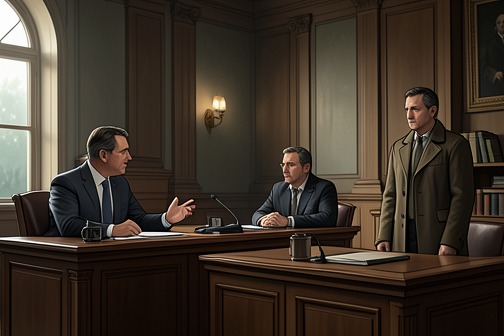
[Jacob Barber murder trial and dismissal](entity:event-recall-event-jacob-barber-82e2aae388fb) is the courtroom crisis at the center of the case: a contest to make the murder of [Ben Rifkin](entity:character-recall-character-ben-rifkin-ee0ef547649e) legible as a story, overturned when [Leonard Patz](entity:character-recall-character-leonard-patz-efe0f3e856b7)’s confession leads the prosecution to abandon its charges. The trial’s decisive shifts are not simply changes in evidence but changes in what the courtroom believes the evidence means—first as a tale of a prepared killer who “snapped,” then as a case badly damaged by testimony, and finally as a prosecution the government no longer pursues.
## The prosecution’s story
The trial begins from the unresolved problem of motive. In his address to the jury, [Neal Logiudice](entity:character-recall-character-neal-logiudice-18b620d30e1e) presents Ben’s death as the culmination of a split-second choice: a fourteen-year-old boy, he argues, took a life after his temper finally snapped. Logiudice describes Ben as found in [Cold Spring Park](entity:location-recall-location-cold-spring-park-c214120d077b) on a spring morning, and stresses how close the park was to both the school Ben was walking toward and the home he had just left. The setting and proximity turn the killing into a rupture of ordinary neighborhood life.
Logiudice’s account depends on a narrative that makes motive understandable to jurors. He tells them that they will hear Ben teased Jacob and acknowledges that Ben was not a saint; at the same time, he insists that ordinary adolescent meanness cannot justify a fatal response. He contrasts Ben, whom he describes as handsome, popular, and cool, with Jacob as quiet, lonely, and an outsider. The contrast gives the prosecution a social script for resentment, but it does not by itself establish what triggered the crime.
The missing trigger remains the weakness inside that script. [Andrew Barber](entity:character-recall-character-andrew-barber-8b47cdbff3c8) observes that Logiudice has to offer possibilities rather than a known explanation, speculating that Ben may have insulted, pushed, or bullied Jacob. The prosecution’s own story therefore exposes a gap between its confident theme and the uncertainty of motive. Andrew reflects that jurors want a logical answer to why a seemingly nonviolent boy would commit a brutal act; where the account cannot provide one, explanatory theories, including the idea of “murder genes,” threaten to stand in for proof.
## A story built for the jury
The trial makes explicit that courtroom persuasion requires more than a collection of facts. Andrew describes Logiudice’s approach as the construction of a “story of the case”: a theme compact enough for jurors to carry into deliberations. Logiudice repeats the idea that Jacob snapped, reinforcing it with a finger snap. His physical manner is equally calculated: he makes eye contact with jurors, comes close to the defense table, and points at Jacob. Andrew considers the method skillful even while rejecting the prosecution’s account as dishonest.
That gap between performance and proof shapes the trial’s narrative tension. Logiudice’s scene-setting turns the case into a comprehensible sequence—teasing, a prepared state of mind, a final trigger, a fatal choice—while Andrew’s narration keeps drawing attention to what the sequence cannot establish. The jury is asked to accept a story that supplies a motive the evidence has not clearly resolved. The trial thus stages a conflict between the persuasive force of a coherent explanation and the criminal case’s need to establish its claims rather than merely make them imaginable.
The courtroom also becomes a public spectacle observed beyond the jury box. Andrew notes that there is, in effect, another jury on the other side of the television cameras. The formal proceedings and their performance for a wider audience coexist, making the trial both a legal contest and a struggle over the family’s public identity.
## The witness and the turn toward conviction
By the sixth day, testimony from [Derek Yoo](entity:character-recall-character-derek-yoo-64a9030f135a) changes the atmosphere. [After](entity:expression-recall-expression-after-f466acd0fe53) Derek’s direct testimony, the courtroom seems to Andrew to have reached a collective decision: the jurors and Judge French appear convinced that Jacob will not leave by the front door, and even a court officer watches him warily. The mood combines relief that the question of Jacob’s guilt seems settled with eagerness for revenge. This is Andrew’s perception of the room, not a verdict, but it marks a sharp emotional turn in his account.
[Jonathan Klein](entity:character-recall-character-jonathan-klein-24d9eee6e9d8)’s cross-examination tries to narrow the effect of what Derek has said. He asks whether the troubling things Derek describes were serious enough to end the friendship, and whether the two boys remained friends for days and weeks after the murder. Derek answers no. Klein continues to test the limits and reliability of the testimony, but Andrew sees little reassurance in the jurors’ response: those who had taken notes during direct examination stop writing, and some look down rather than at the witness.
The apparent quiet does not restore Andrew’s confidence. He begins, for the first time, to picture Jacob in [Concord prison](entity:location-recall-location-concord-prison-a71d57d0da7e) and concludes that the defense cannot safely rely on reasonable doubt alone. In his judgment, Jacob’s story about the murder reads like a confession, while Derek’s account remains damaging despite the cross-examination. The trial has shifted from a defense hoping the prosecution’s case will fail to a defense that must present an affirmative answer to it.
## Patz’s confession and the dismissal
The reversal arrives outside the courtroom. At five-thirty in the morning, Andrew receives a call from Jonathan Klein. [Jonathan](entity:character-recall-character-jonathan-c07ebc6c5e21) reports that Leonard Patz, after being served with a subpoena, has died by suicide and left a confession. The handwriting has been checked, and Jonathan tells Andrew that the note is authentic. For the Barbers, the news changes the case at once, though the family waits for the legal consequence rather than treating the confession as sufficient by itself.
Before the judge takes the bench, Neal Logiudice files a nol pros, formally announcing the government’s decision to drop the charges. Jonathan does not have to make the dismissal motion he had expected to bring. At nine, Judge French tells Jacob that he is free, and the clerk reads the order discharging him from the indictment and returning the bail to the surety. The operative phrase, “go without day,” means that no further court date is scheduled in the matter. The indictment is dismissed, and the proceedings against Jacob end.
The release brings immediate relief: Jacob and Andrew embrace, and the family leaves amid reporters, running and laughing toward the garage. They thank Jonathan, who declines to claim credit, saying he had not actually done anything. Yet the legal ending does not erase the trial’s earlier uncertainty. The family experiences Patz’s confession as more than a not-guilty verdict—Andrew says it feels as if Jacob has been proven innocent—but the evidence presented here establishes the charges’ dismissal, not a complete account of every uncertainty that surrounded the murder.
## What the trial leaves unresolved
The trial’s structure keeps two conclusions in tension. Inside the courtroom, Logiudice’s theme of a boy who snapped supplies a memorable explanation, while Andrew’s account exposes how much of the prosecution’s motive remains conjectural. Derek’s testimony then appears to persuade the room, and the defense’s attempts to qualify it do not prevent Andrew from imagining a prison sentence. Patz’s confession abruptly changes the legal course, but it arrives after the trial has already made guilt feel settled to those in the courtroom.
The dismissal consequently ends the prosecution without making the process itself a reliable instrument of certainty. A story can dominate the room before all the evidence is heard; a witness can alter the apparent balance of the case; and a confession can overturn that balance before the judge issues a verdict. Jacob leaves the courthouse legally free, while the sharply different courtroom stories remain part of the trial’s significance: the case concludes through the state’s withdrawal, not through a jury resolving the competing accounts.
Event 31
Leonard Patz’s confession and death
[Leonard Patz’s confession and death](entity:event-recall-event-leonard-patz-ef0a1280f272) bring the prosecution of [Jacob Barber](entity:character-recall-character-jacob-barber-72f25e661d23) to an abrupt legal end, but do not settle what happened or erase the costs of the case. Patz dies after being subpoenaed to testify and leaves a confession investigators verify as authentic; the government then dismisses the indictment against Jacob. Later, [Andrew Barber](entity:character-recall-character-andrew-barber-8b47cdbff3c8) suspects that James “Father” O’Leary forced the confession, making the apparent resolution both an exoneration in court and a source of enduring uncertainty.
## The confession and its timing
[Jonathan Klein](entity:character-recall-character-jonathan-klein-24d9eee6e9d8) had Patz served with a subpoena, as he had promised the court. The next night, Patz died by suicide, leaving a full confession. Klein told Andrew that investigators had been at Patz’s apartment all night and had confirmed the handwriting; the note was genuine. The news initially seemed almost impossible to believe, but its timing made it decisive: the case against Jacob had been approaching its courtroom reckoning, and the confession identified another person as responsible.
Klein planned to move for dismissal when court opened. Before that could happen, however, [Neal Logiudice](entity:character-recall-character-neal-logiudice-18b620d30e1e) filed a nol pros, formally announcing the government’s decision to drop the charges. The order therefore came not through a jury’s assessment of competing evidence but through the prosecution’s decision in response to the newly verified confession.
## Jacob’s release
At nine o’clock, the judge took the bench and asked Jacob to stand. He told Jacob that he was a free man, prompting a cheer and an embrace between Jacob and Andrew. The clerk then read the formal discharge: the Commonwealth had entered a nolle prosequi, Jacob was discharged from the indictment and could go without day, and the bail previously posted could be returned to the surety. The case was dismissed.
For Andrew and [Laurie](entity:character-recall-character-laurie-6a86783f9333), the news first arrived as a sudden reversal after a long trial. They woke Jacob and shared the confession with him, then waited in their trial clothes to go to the courthouse. They watched television and checked [Boston](entity:location-recall-location-boston-aded649f4602).com for a report of Patz’s death, but found none. Their relief was intense, yet they held back from celebrating fully until the dismissal was official, knowing Logiudice might still continue the prosecution. The judge’s order transformed the news into a legal outcome: Jacob was no longer facing the indictment.
## Rescue and the lost verdict
Andrew experiences the dismissal as more than an acquittal. In his account, a not-guilty verdict would mean only that the prosecution had failed to prove its case; Patz’s confession seemed to him to establish Jacob’s innocence and erase the ordeal. That distinction explains the family’s near-miraculous sense of rescue, but it also exposes how much their relief depends on accepting the confession as conclusive.
Later, Andrew confronts his father, William “Bloody Billy” Barber, about the confession. Andrew says he believes James “Father” O’Leary went to Patz’s apartment after a particularly bad day for Jacob in court, frightened him into signing a confession, and then left him dead. The account is Andrew’s reconstruction, not a demonstrated finding: Billy does not answer, and Andrew recognizes that the two men understand the same bind—without a confession, there is no case; without a case, there is no confession.
Billy calls the intervention an act that saved Jacob’s life. Andrew rejects that defense. In his view, O’Leary’s alleged intervention took away Jacob’s chance to hear a jury say he was not guilty. Even with the indictment dismissed, Andrew fears that people will continue to believe Jacob was a murderer. The event therefore closes the prosecution without producing the public, adversarial verdict Andrew considers necessary to clear his son’s name.
## Legal closure, unresolved truth
The confession functions as a turning point because it changes the state’s case and Jacob’s legal status almost at once: the charges are dropped, and the court formally discharges him. But the novel distinguishes that procedural closure from certainty about the confession’s origin. The handwriting is authenticated and Patz’s confession is accepted as genuine; Andrew’s later suspicion concerns how it was obtained, not whether the note existed.
That gap leaves the outcome double-edged. Jacob is free of the indictment, yet Andrew believes the missing trial has deprived him of the strongest possible public vindication. Billy’s claim that the intervention saved Jacob and Andrew’s insistence that it denied him his day in court turn the same act into incompatible judgments: protection and loss. The case ends in law, while doubt about the means of its ending remains.
Event 32
Hope Connors’s disappearance and death

[Hope Connors’s disappearance and death](entity:event-recall-event-hope-connors-17a18a4e6826) shatter the Barbers’ brief return to family happiness at [Waves](entity:location-recall-location-waves-b1c019d73560), the resort where she and Jacob begin a relationship. She vanishes during an afternoon when her absence initially seems ordinary; seven weeks later, her body is found on a distant shore. The account never settles whether she drowned accidentally or was killed, and the uncertainty acquires force from the family’s earlier experience of Jacob’s murder case: suspicion, media attention, and disputed evidence gather around him again, without resolving what happened.
## A brief romance at Waves
The episode begins inside the holiday’s apparent reprieve. The Barbers have settled into the beach-and-pool rhythm at Waves, with buffet meals, evening entertainment, and the resort’s insistence on exuberant fun. Jacob spends much of his time with Hope, increasingly leaving his parents’ company to be alone with her. For the first time in a long while, he seems happy in someone else’s presence.
That happiness rests on a concealed identity. Jacob tells Hope his name is Jacob Gold, using [Laurie](entity:character-recall-character-laurie-6a86783f9333)’s maiden name, and she does not know about the case. Andrew and Laurie learn of the false surname only later. At the time, they wonder whether Hope has somehow missed the extensive attention surrounding Jacob or knows about it and is drawn to the notoriety; they avoid asking her directly because they fear spoiling what appears to be the first good thing in Jacob’s life for a long while.
The family’s glimpses of the couple are small and tentative. Even when Hope and Jacob come over to greet them at the pool, the young people then sit a little apart. Once, the parents see them holding hands furtively on neighboring chaise lounges. Andrew remembers Hope as courteous and warm, with blond hair and a soft Virginia accent, and emphasizes that she seemed comfortable in her own body. Her presence brightens Jacob. The name Hope, Andrew reflects, gives her sudden entrance an almost fairy-tale symmetry; he jokes to Laurie that at last they have hope.
## The disappearance
As evening approaches, Hope’s mother telephones their room to ask whether Hope is with Jacob; she has not heard from her all afternoon. Andrew cannot recall exactly when he later learned that Hope had vanished, but he remembers the call and its initially reassuring context. Jacob shrugs when asked. There is no cell-phone reception at the resort, and the teenagers have often been temporarily out of contact. The resort is fenced and regarded as safe. Andrew and Hope’s mother both assume she may have gone exploring or lost track of time, and Andrew tells her not to worry because Hope will probably return shortly.
She does not. In the grand-jury account, Andrew gives the disappearance its bluntest form: Hope never came back. That sentence retrospectively overturns the casual explanation that had seemed reasonable at the time. What began as a familiar vacation uncertainty becomes an absence with no immediate answer, and the apparent security of the fenced resort offers no explanation for where Hope went or what happened to her.
The narrative sets this rupture against the Barbers’ carefully recovered routines. They had begun watching the sunset as a family, dragging three beach chairs to the water’s edge and sitting with their feet in the water. Hope joined them once, sitting beside Laurie; usually the ritual belonged to the three Barbers. Andrew later pictures them there as a happy, apparently ordinary family and wants to freeze the story at that image. Hope’s disappearance breaks into this remembered tableau from the next stage of the testimony, converting the holiday’s dreamlike ease into a memory marked by what was still unknown.
## Discovery and disputed cause of death
Hope’s body is not found until seven weeks after her disappearance. It washes ashore several miles from the resort. Andrew’s understanding is that she drowned, but he is careful in his testimony about the limits of what he knows: the body had been in the water for a long time, had deteriorated, and, as he understood it, had been fed on by marine life. He was not privy to the investigation, and he says the remains yielded little evidence.
The cause of death is therefore presented through competing claims rather than a settled reconstruction. Andrew maintains that the evidence supports only that Hope went swimming and drowned. The prosecutor counters that there is evidence her windpipe was crushed before she entered the water, a detail that raises the possibility of homicide. Andrew rejects that inference, arguing that the condition of the body did not support it and that the investigation in the resort’s location was compromised by intense media and public pressure. He describes the local police investigation as improperly conducted; his criticism does not, however, establish what happened to Hope.
The testimony preserves the gap between a possible sign of violence and proof of a killing. Asked whether the case is considered an unsolved homicide, Andrew says he does not know and disputes that the evidence warrants the label. The exchange leaves the death unresolved: drowning is Andrew’s account of what the evidence suggests, while the alleged injury to Hope’s windpipe remains an opposing interpretation voiced in questioning.
## Jacob under renewed suspicion
The prosecutor draws a connection between Hope’s case and Jacob’s earlier prosecution, calling him an exceptionally unlucky boy after describing a murder and what the prosecutor characterizes as a botched investigation. Andrew challenges whether the remark is even a question. The parallel is consequential precisely because it is not a resolution: it brings Jacob’s name into another case involving a young woman’s death while leaving the evidence and responsibility unsettled.
By the time of the grand-jury testimony, Jacob’s name has been widely linked to Hope’s case in tabloids and on websites Andrew calls sleazy. He dismisses those outlets as willing to say anything for money and argues that there is no profit in claiming Jacob was innocent. The testimony thus places the family’s private uncertainty inside a public narrative that treats association as insinuation. The earlier murder case has not simply ended with Jacob’s exoneration; his name remains available to media speculation when Hope disappears and dies.
## Memory, grief, and the unfinished ending
The book’s treatment of the event is shaped by hindsight. The resort episodes are remembered as a short-lived interval in which Jacob has a girlfriend, the parents begin repairing their marriage, and the family can sit together at sunset. Andrew’s wish to hold that scene still is answered by the testimony’s abrupt sequence: a girl disappears; weeks later, her body is found; the evidence is disputed. The shift from intimate family recollection to formal questioning makes the vanished person both a presence in the remembered holiday and the center of a case the family cannot explain.
The contrast also echoes [Dan Rifkin](entity:character-recall-character-dan-rifkin-fccce31db74f)’s earlier struggle to understand why someone would commit a murder and his plea for answers beyond evidence and court procedure. He asks what enables some bereaved parents to carry on, and what happens to those who never recover. In another recollection, Andrew sees Dan alone in a vast, empty field at [Cold Spring Park](entity:location-recall-location-cold-spring-park-c214120d077b), a small figure with his head bowed and his hands pushed into his coat pockets, buffeted off course by the wind. That image belongs to the aftermath of [Ben Rifkin](entity:character-recall-character-ben-rifkin-ee0ef547649e)’s death, not Hope’s, but it gives the book’s later treatment of loss a continuing human context: official answers and the passage of time do not automatically quiet grief.
Andrew’s broader reflection on life after Jacob’s exoneration likewise resists a clean ending. He describes life as a long succession of ordinary days, punctuated by a few momentous ones, and observes that people shape those days into tidy stories even though the end is never simply the end. Hope’s disappearance and death sharpen that idea. The Barbers’ remembered vacation cannot remain a sealed happy episode, and the testimony cannot convert uncertainty into closure. Hope is gone, the circumstances of her death remain contested, and Jacob’s association with the case renews the shadow of suspicion around a family that had only briefly imagined it might be living an ordinary life.
Event 33
Laurie Barber’s bridge-abutment crash that killed Jacob
[Laurie Barber’s bridge-abutment crash that killed Jacob](entity:event-recall-event-laurie-barber-jacob-e881d4752ef3) is the devastating final reversal in the Barber family’s story: after Jacob is cleared of murder, his mother drives their minivan into a concrete abutment, killing him and surviving with serious injuries. The novel reveals the collision first through [Andrew Barber](entity:character-recall-character-andrew-barber-8b47cdbff3c8)’s testimony about the news he received, then returns to the road in an imagined reconstruction shaped by his grief. The separation between what Andrew knows as a witness and what he repeatedly pictures as a father makes the crash both a fatal event and an enduring, unresolved memory.
## Causes and Circumstances
The crash follows the family’s return from [Jamaica](entity:location-recall-location-jamaica-5c4836c83849) and the collapse of any easy prospect of normal life after Jacob’s release. Their vindication brings a brief euphoria, but it does not restore what the trial and its aftermath have taken from them. The family settles into a narrow routine, avoiding public places where they feel watched; [Laurie](entity:character-recall-character-laurie-6a86783f9333) in particular will not risk meeting the Rifkins at the market. Jacob’s future is constricted too. Schools are reluctant to accept him, and the town will not fund homeschooling under a special-education plan until other options have been exhausted. The interviews arranged for him feel less like genuine opportunities than repeated occasions to be rejected and inspected as a notorious former defendant.
On the morning of the collision, Laurie is driving Jacob to an interview at a private school in Natick. Their silence in the car reflects the damaged trust between them. Since the family’s return from Jamaica, Laurie has been quiet and withdrawn; Jacob gives her space, while understanding that he has lost her trust even if he has not lost her love. They exchange only a few strained words on [Route 128](entity:location-recall-location-route-128-82385637d928), then fall silent as they join the [Massachusetts Turnpike](entity:location-recall-location-massachusetts-turnpi-db46d9874947) traffic. The school interview is another likely humiliation for Jacob, but neither passenger speaks openly about the strain between them.
The collision is presented with two kinds of knowledge kept sharply apart. In the courtroom, Andrew reports what Lieutenant [Paul Duffy](entity:character-recall-character-paul-duffy-dea30aca2158) told him: there were no other cars involved, and other drivers saw Laurie steer toward the bridge abutment without braking or swerving away. They reported that she accelerated toward it. Their first explanation was that the driver must have lost consciousness or suffered a heart attack. The witness account establishes the deliberate-seeming course of the vehicle, but the novel does not provide a separate explanation from Laurie for why she drove into the barrier.
## The Drive and Collision
Andrew was not in the minivan. He nevertheless reconstructs the final ride in detail, returning in thought to a scene he says he relives every day and dreams about at night. In his imagined account, Jacob is stretched out in the middle row, as he habitually was, and is not wearing his seat belt. Laurie would ordinarily have told him to buckle up, but that morning she does not. The small omission becomes part of the awful sequence Andrew cannot stop replaying.
As the drive continues, Laurie begins to cry and grips the steering wheel. Jacob does not notice; his attention is fixed on the road ahead. Laurie signals, moves into the less crowded right lane, and accelerates through the high seventies and eighties. She unclips her seat belt and passes it back over her shoulder. When the minivan exceeds 85 miles per hour, Jacob remarks that she is going fast. Her answer is an expression of love for him and for Andrew, not an explanation of her actions. Jacob reaches for the belt only when he realizes that something is seriously wrong, but there is no longer time to fasten it.
The minivan keeps accelerating as it enters the breakdown lane and descends a slight hill, reaching the upper nineties. Jacob calls for Laurie to stop. She drives directly at a molded-concrete abutment set into the hillside. A Jersey barrier is meant to guide a vehicle away from a direct impact, but the minivan approaches too fast and at too direct an angle. The barrier lifts its right-side wheels; the van skitters up the wall, vaults over the barrier, and rolls almost upside down. Laurie retains her grip on the steering wheel as the vehicle loses control and overturns.
Andrew’s reconstruction ends at the instant the van is airborne. He imagines Jacob thinking of his father and understanding, at last, that Andrew loved him regardless of what he might have done. That imagined recognition is not evidence of Jacob’s actual thoughts; it is the grieving father’s effort to place his love inside the final seconds of a death he did not see. The narration makes the limit explicit even as it crosses it: Andrew knows he was absent, but cannot keep himself from picturing what happened.
## Death, Testimony, and Aftermath
The news arrives at Andrew’s door around nine in the morning. Paul Duffy asks to come in and sit down, but Andrew insists that he tell him there. Duffy says there has been an accident on the turnpike: Laurie and Jacob were in the car, the vehicle left the road, Jacob is dead, and Laurie is badly hurt but expected to survive. At the later testimony, Andrew’s account breaks off after he reports the news. When asked whether anything else happened, he says he is all right, but his pauses register the difficulty of turning that disclosure into a courtroom narrative.
The prosecutor, [Neal Logiudice](entity:character-recall-character-neal-logiudice-18b620d30e1e), states directly that Laurie murdered Jacob. Andrew does not respond. The testimony thus places a legal interpretation beside the bare facts Duffy conveyed and the observed acceleration, but does not dissolve the uncertainty of motive. The crash is presented as a death caused by Laurie’s driving; the courtroom accusation cannot make Andrew’s loss intelligible or give the reader access to Laurie’s private reasoning.
The end of the family’s legal ordeal had once seemed like a decisive new beginning. Andrew reflects that Jacob’s exoneration was one of the few days that mattered in a life otherwise made up of repetitive, forgettable days, but that the ordinary days continued afterward. “The End” was not the end: vindication did not return the family to normal, and the crash turns the hoped-for future into another irreparable before-and-after. Andrew’s account leaves the reader with no recovery or reconciliation to follow, only the father’s continuing return to the last moments of Jacob’s life and the love he imagines his son recognizing as the vehicle strikes the wall.